5-Axis or 3-Axis: Which One Your Part Needs and How the Quote Moves
A 5-axis machine costs more per hour than a 3-axis machine, yet the 5-axis quote is sometimes the lower one. The difference comes from how many times the part has to be unclamped and turned, not from the cutting itself. This guide shows what drives that difference so you can read a quote and decide what to ask for.
What the axes actually mean
A 3-axis machine moves the cutter along X, Y and Z. The part sits on the table in a fixed orientation, so the cutter can only reach the faces that point up or sideways to it. To machine a second face you stop the machine, unclamp the part, turn it and clamp it again.
A 5-axis machine adds two rotary axes. Depending on the design, either the table tilts and rotates or the spindle head swivels. The cutter can then approach the part from many angles in one clamping. There are two ways to use that ability:
- 3+2 or indexed work: the rotary axes move to a set angle and lock, then the cutter runs a normal 3-axis program. This is common, reliable and cheap to program.
- Simultaneous 5-axis: all five axes move together while cutting. This is needed for impellers, turbine-style blades, contoured medical shapes and some mould surfaces.
Many parts sold as “5-axis parts” only need 3+2. Ask which one your quote assumes, because the programming and machine rate differ.
Where the money goes in a quote
The shop prices four things: machine time, setup time, fixtures and programming. Axes change all four.
| Cost element | 3-axis | 5-axis (3+2 or simultaneous) |
|---|---|---|
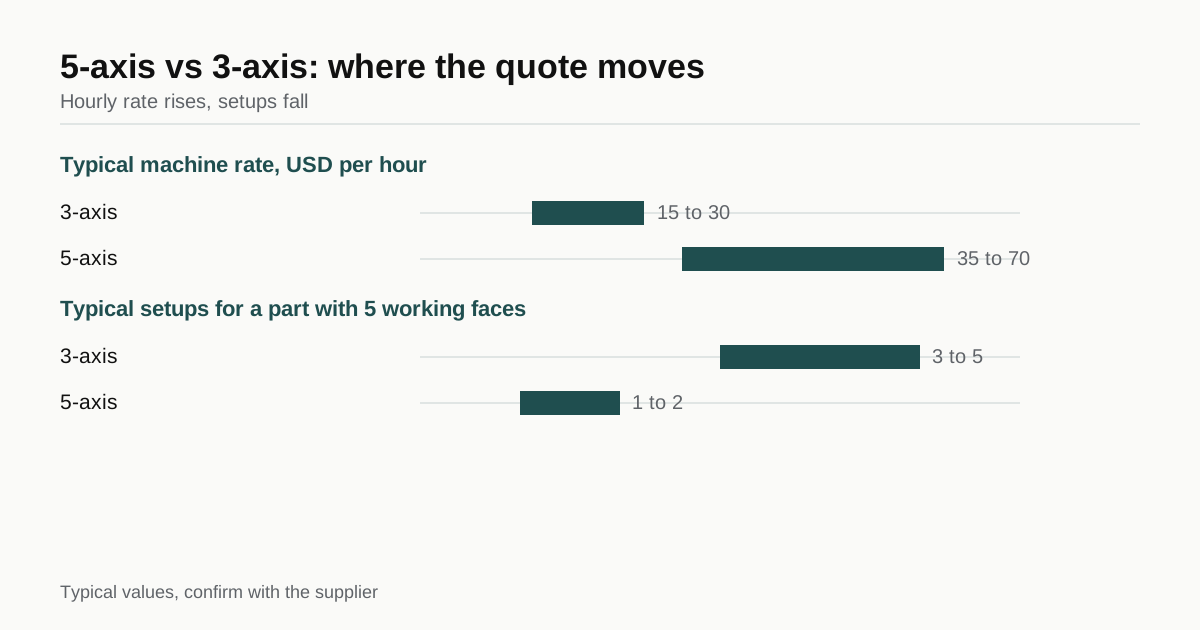
| Machine rate per hour | Lower | Typically 1.5 to 2.5 times higher |
| Setups for a part with 5 working faces | 3 to 5 | 1 or 2 |
| Fixture cost | One fixture per setup | One fixture, often a simple vise with soft jaws |
| Programming | Short per setup, repeated | Longer, especially for simultaneous cutting |
| Handling and wait time | High, each unclamp adds a queue | Low |
Typical shop rates in Vietnam sit around USD 15 to 30 per hour for 3-axis and around USD 35 to 70 per hour for 5-axis. These are typical figures only and each shop sets its own, so confirm in the quote.
The effect of setups is easy to underestimate. A part with features on five faces can need four setups on a 3-axis machine. Each setup costs an operator, a fixture, a probing routine and a first piece check. On a small batch these costs divide over few parts, so the unit price rises fast. That is why a 5-axis quote can win on batches of 10 to 100 pieces.
Tolerance stack is the quieter reason
Every time a part is unclamped and clamped again, the position of the new face relative to the old one carries a small error from the clamping. Features machined in the same setup share one datum and stay aligned to each other. Features machined in separate setups only match to the repeatability of the fixture and the operator.
If the drawing holds position or perpendicularity between features on different faces tighter than about 0.03 mm, a single-setup process is the safer route. If the same relationship is only 0.1 mm, a 3-axis process with a good fixture handles it. The tolerance guide explains how to decide which features deserve the tight call-out.
Parts that usually justify 5-axis
Look at your drawing for these signs:
- Angled holes or faces at compound angles to the main faces
- Undercuts that a straight tool on a 3-axis machine cannot reach
- Deep pockets with a narrow opening, where tilting the part lets a shorter and stiffer tool cut
- Five or more machined faces on one part
- Contoured or freeform surfaces, such as an organic housing or a blade shape
- Tight position between faces that a single clamping protects
Tool length matters more than most buyers expect. A long, thin tool deflects, chatters and leaves a poor finish. Tilting the work so a shorter tool can reach the same depth often improves both the surface and the cycle time.
Parts that should stay on 3-axis
A flat plate with pockets and holes on two faces gains nothing from a 5-axis machine. Brackets, simple housings, base plates, spacers and most prismatic parts with features on the top and one other face are quicker and cheaper on a well-tooled 3-axis machine, sometimes with a second operation on a 4th-axis rotary table. At higher volumes, a dedicated fixture holding several parts per cycle makes 3-axis hard to beat on cost.
Do not request 5-axis capability for its own sake. If the machine list impresses you but the part is simple, you pay a higher rate for no benefit.
How to ask for the right quote
The most useful request puts both routes on the table. State the quantity, the material and the tolerance on the relationship between faces, then ask the shop to say which route it chose and why. A good answer names the number of setups and the fixture approach.
In your request, include:
- A 3D model (STEP) together with the drawing, so the shop can check reach and angles
- The target quantity and any repeat quantities, because fixture cost spreads across them
- Which features carry tight tolerances, marked clearly on the drawing
- A statement that you accept either route if the tolerances are met
A shop that recommends 3-axis for a simple part is being straight with you. A shop that recommends 5-axis for a part with five faces and a tight position call-out probably has the arithmetic on its side. The quote breakdown guide shows how to read the lines that follow.
A worked comparison
Take a small aluminium housing with features on five faces and a 0.03 mm position call-out between two bores on different faces. On a 3-axis machine the shop plans four setups, each with a fixture or soft jaws, and runs the part in four visits to the machine. Say each setup takes 20 minutes to prepare and the cutting totals 35 minutes. On a 5-axis machine the same part runs in one or two clamping steps, setup takes 30 minutes and the cutting totals about 30 minutes because shorter tools run at better feeds.
For a batch of 20 pieces, the 3-axis route carries four setups of 20 minutes each, which is 80 minutes spread over 20 parts, plus the lower hourly rate. The 5-axis route carries 30 minutes of setup but a higher hourly rate. The totals land close together, and the 5-axis route usually wins on position accuracy because both bores share a datum. For 500 pieces the 3-axis route can win again if the shop builds a multi-part fixture. The point is not that one route is right. The point is that the answer comes from the arithmetic, so ask the shop to show its route.
Checking capability before you commit
A machine list is a start, not proof. Ask for:
- The machine brand and model, and whether it runs simultaneous motion
- The CAM software used for 5-axis programs
- A sample part or photograph with a similar shape
- How the shop verifies a part after the final setup, for example with a CMM or a height gauge
For a first order, a first article inspection gives you evidence before the full batch is made. The first article inspection guide covers what to request.
Design changes that make either route cheaper
Small drawing changes reduce cost on both machines. Keep internal corner radii at a standard cutter size, avoid pockets deeper than about four times their width, and put angled features on as few faces as you can. A design that avoids a compound angle may let a part move from 5-axis to 3+2 or even to 3-axis. The design changes guide lists changes that usually pay back.
Summary checklist
Before you request a quote, check these points:
- Count the faces that carry machined features
- Mark any angled or undercut features
- Decide which relationships between faces need a tight tolerance
- Send a STEP model along with the drawing
- Ask each shop to state its number of setups and its machine type
- Compare unit price at your real quantity, not only at one piece
When the drawing is ready, send it through the RFQ form and up to three shops in Vietnam will answer with their own route and price. We reply within 24 business hours.
Frequently asked questions
Is 5-axis machining always more expensive than 3-axis?
No. The hourly rate of a 5-axis machine is higher, but a part that needs four or five setups on a 3-axis machine can cost less on a 5-axis machine because setups, fixtures and handling disappear. The crossover depends on the part, so ask for both quotes on any part with features on three or more faces.
What is 3+2 machining?
It is 5-axis equipment used with the two rotary axes locked at a fixed angle while the cutter moves in X, Y and Z. It reaches angled faces in one clamping without the programming cost of full simultaneous motion, and many shops quote it close to 3-axis rates.
Can a shop in Vietnam run simultaneous 5-axis work?
Some can and many cannot. Ask whether the machine does full simultaneous motion or only indexed 3+2, which spindle brand and control it uses, and which parts of similar shape it has made. Do not assume a 5-axis label on a machine list means simultaneous cutting.
Need a quote for a part like this?
Send the drawing. We shortlist up to 3 machine shops in Vietnam, manage the order if you want us to and reply within 24 business hours.
Send my RFQ