Swiss-Type Turning: When a Small Lathe Part Needs a Sliding-Headstock Machine
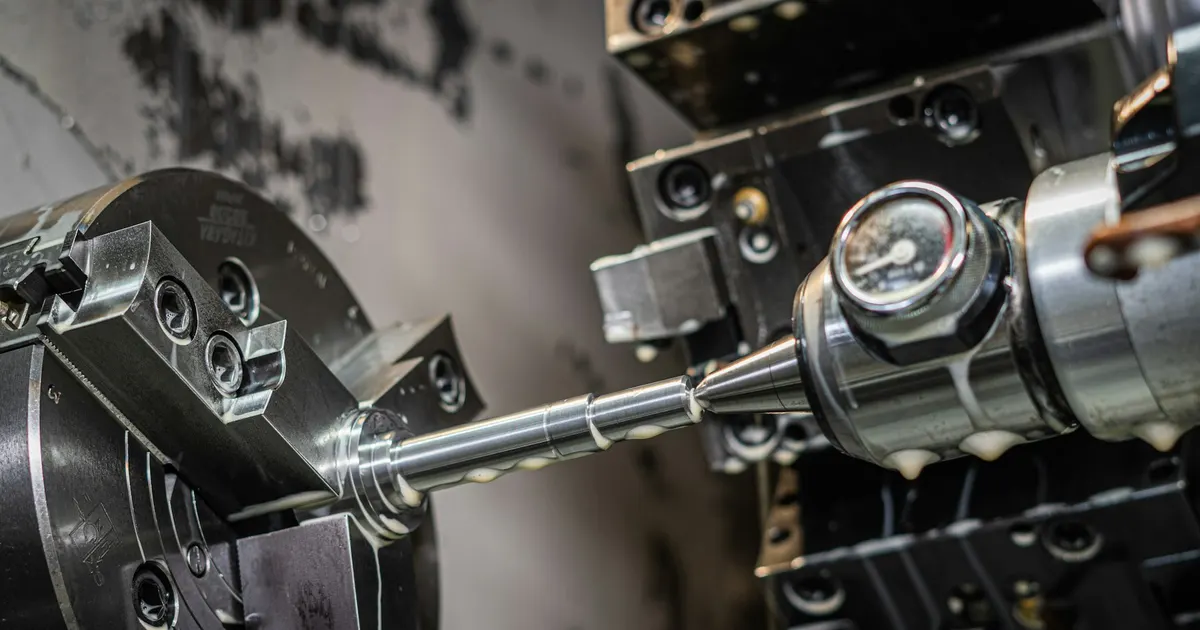
A Swiss-type lathe is not a more precise version of an ordinary CNC lathe. It is a different machine built around one idea: the bar slides through a guide bushing and the cutting tools work right next to it. That supports the part where it is cut, which is why long, thin and small parts come off clean. Knowing when your part fits that idea, and when it does not, saves money on both sides of the quote.
How a Swiss-type lathe works
On a standard CNC lathe the bar is held in a chuck and the tool moves toward it. The farther the tool is from the chuck, the more the work can flex under the cut. On a Swiss-type machine the headstock itself moves along the Z axis and feeds the bar through a guide bushing. The tool cuts a few millimetres from the bushing, so the unsupported length stays short whatever the total length of the part.
Three further features make Swiss-type machines productive:
- Live tooling lets the machine mill flats, cross holes and slots while the part is still held, without a second machine
- A sub-spindle picks up the part at the end of the cycle and machines the back end, so a finished part drops out
- A bar feeder loads the next bar automatically, which allows long unattended runs
The outcome is a complete part from a single cycle, with no secondary operations for many designs.
Parts that belong on a Swiss-type machine
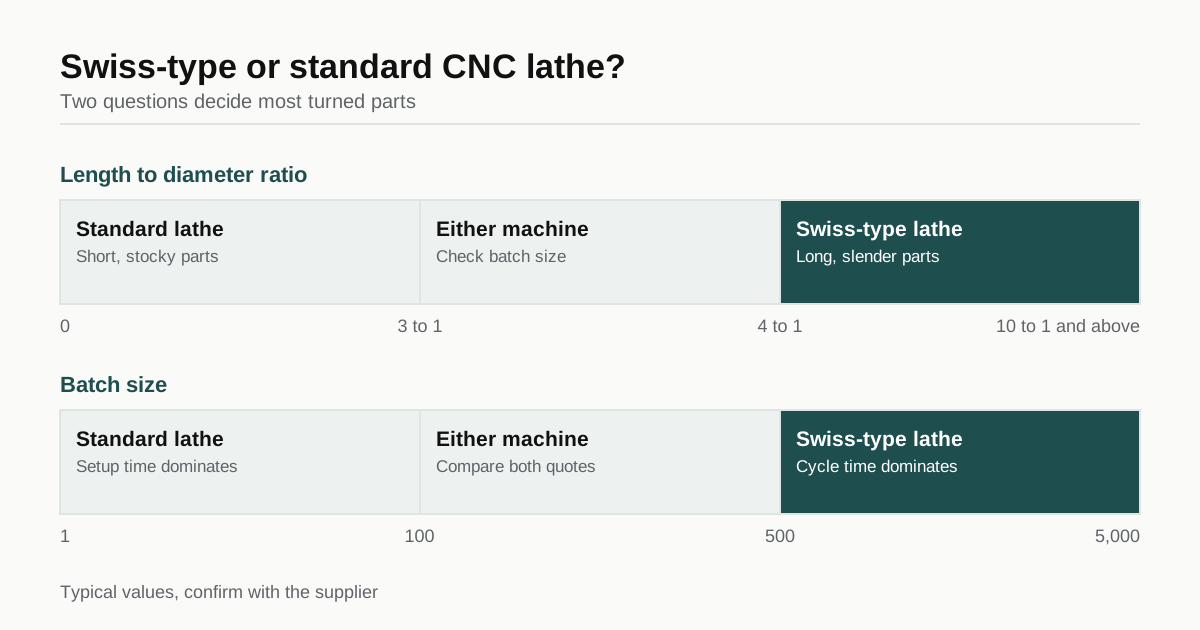
The clearest signal is a slender shape. A length-to-diameter ratio above about 3 or 4 to 1 is where a Swiss-type machine starts to pay off, and ratios of 10 to 1 or more are routine. Other typical candidates:
- Pins, shafts, dowels and spindles under about 20 mm diameter
- Medical screws, dental components and small implant-style parts
- Connector pins, contacts and electronic terminals
- Fasteners and fittings with cross holes, flats and threads
- Watch and instrument parts
- Small hydraulic and pneumatic valve parts
If your part is under about 32 mm in diameter, is made in volume and needs several operations, ask whether a Swiss-type machine fits.
Parts that should stay on a standard CNC lathe
A short, fat part has nothing to gain from a guide bushing. Flanges, hubs, wheels, large bushings and discs run well on a standard lathe, which has a faster setup and handles larger diameters. Parts that need to be machined from a forged or cast blank, rather than from bar, also belong on a chuck lathe. The same applies to a one-off prototype where the setup time of a Swiss-type machine would dominate the price.
| Question | Swiss-type lathe | Standard CNC lathe |
|---|---|---|
| Typical bar diameter | Up to 20 to 32 mm (larger models exist) | From small up to 100 mm and more |
| Best length-to-diameter ratio | Above about 4 to 1 | Below about 3 to 1 |
| Setup time | Longer | Shorter |
| Best batch size | Hundreds to many thousands | One piece to a few hundred |
| Bar quality needed | Ground or precision-drawn bar | Standard bar is usually fine |
| Secondary operations | Often none | Often a milling step later |
All values are typical. A shop’s own experience with the part shape matters more than the table.
What the bar needs to be
A guide bushing is bored to a size close to the bar. If the bar is out of round or oversized, it jams or marks the part. Shops therefore use bar with tight diameter tolerance, usually a ground or precision-drawn grade such as h9 or better. Material availability in this grade can be limited for some alloys, so ask early. For stainless steel and free-machining brass the bar is easy to find. For titanium or high-temperature alloys, supply can add to the lead time.
If you specify an unusual grade, check the materials guide and confirm that the shop can buy the bar in the diameter you need, with a mill certificate.
Tolerances you can reasonably ask for
On a slender part, a Swiss-type machine commonly holds diameters within plus or minus 0.01 mm, and plus or minus 0.005 mm with careful process control on suitable material. Concentricity between a front and back feature is good because the sub-spindle transfer keeps the part aligned. As usual, the tolerance you write is the tolerance you pay for. Tighter than plus or minus 0.01 mm calls for in-process gauging and a stable shop temperature, and it adds time to the inspection step.
Surface finish from fine turning on this type of machine is typically Ra 0.4 to 0.8 micrometres. That is generally enough for a bearing seat or a sealing surface without grinding. The surface finish guide explains what to call out.
Typical problems and how they show up
Swiss-type turning has its own failure modes, and knowing them helps you read a shop’s answers. Bar that is slightly oversize leaves witness marks on the part from the bushing. Long parts with a thin section at the cut-off end can bend when the sub-spindle grips them, so shops choose the transfer point with care. Chip control matters too: long stringy chips from stainless steel or aluminium can wrap around a thin part and scratch it, which is why programs include chip-breaking passes and high-pressure coolant.
None of these are reasons to avoid the process. They are the reasons a shop with real Swiss-type experience quotes a little higher than a shop that is guessing. If one price is far lower than the other two, ask what machine and what bar the low quote assumes.
What to ask a shop in Vietnam
Many shops in Vietnam run standard CNC lathes and mill-turn machines. Fewer own Swiss-type machines, so ask the question instead of assuming the answer. When you send an RFQ for a turned part, ask these questions:
- Does the shop run a Swiss-type machine, and which maximum bar size
- Has it made parts of the same length-to-diameter ratio before
- Does the machine have a sub-spindle and live tooling
- Is a bar feeder used, so the price assumes an unattended run
- How is the diameter checked during the run: gauge, air gauge or laser micrometer
A shop that answers in specifics knows its machine. A shop that answers in general terms may be quoting the part on a machine that does not suit it.
How batch size changes the price
The quote has two parts: a setup cost and a cycle cost. A Swiss-type machine has a higher setup cost and a lower cycle cost. A part with a cycle time of 40 seconds versus 3 minutes on another machine gains the difference on every piece. At 50 pieces the gain is small and the setup dominates. At 5,000 pieces the cycle time dominates, and the Swiss-type route usually wins.
Ask for prices at three quantities, for example 100, 500 and 2,000, and see where the curve flattens. The minimum order quantity guide explains how shops set those thresholds.
Materials that suit the process
Swiss-type machines run most turnable metals and plastics. Free-machining grades give the best result: 303 stainless steel, C360 brass, 12L14 leaded steel and 2011 aluminium. Alloys that are harder to cut, such as 316L, 17-4 PH and titanium, run well too, with slower speeds and more tool wear. Plastics such as PEEK and POM work, though the guide bushing needs a setup that does not mark the rod. For brass and copper, see the brass guide, and for stainless grades the stainless guide.
Ask which material the shop runs most often. A shop that turns stainless daily will set up faster and scrap less on your stainless part than a shop that has done it twice.
Using a Swiss-type machine for prototypes
For a first sample, a standard lathe or a mill-turn machine is often the faster and cheaper path, even for a slender part. A shop can turn five pieces by supporting the part with a tailstock or a steady rest. Once the design is confirmed and volume is visible, move the part to a Swiss-type machine with a proper program. This is the same step covered in the prototype to production guide, and it avoids paying for a long Swiss setup on a drawing that may still change.
Checklist for a turned-part RFQ
- Overall length and maximum diameter on the drawing
- Material grade and bar condition, for example ground bar
- Which diameters and lengths carry tolerances
- Thread callouts with class
- Required quantity and expected repeats per year
- Surface finish and any coating
- Inspection method you expect, and the first article report if needed
Once those are on the drawing, send the RFQ and up to three shops in Vietnam will each state which machine type they plan to use. We reply within 24 business hours.
See also: CNC turning in Vietnam, covering every lathe class, bar supply and typical tolerances.
Frequently asked questions
What is the largest bar diameter a Swiss-type lathe can run?
Most Swiss-type machines take bar up to 20 or 32 mm, and larger models reach 38, 42 or 65 mm. Ask the shop for the maximum bar size of the exact machine it plans to use, because the same shop may own both small and large models.
Does a Swiss-type lathe hold tighter tolerances than a standard lathe?
On long and slender parts, yes, because the cut happens right next to the guide bushing and the bar cannot flex. On short parts the two machine types hold similar tolerances, so the choice should come from the length-to-diameter ratio and the batch size.
What is the minimum batch size that makes Swiss turning sensible?
There is no fixed number, but setup on a Swiss-type machine takes longer than on a standard lathe, so very small batches of a few pieces are usually cheaper elsewhere. Once a part repeats in hundreds or thousands, the short cycle time starts to pay for the setup.
Need a quote for a part like this?
Send the drawing. We shortlist up to 3 machine shops in Vietnam, manage the order if you want us to and reply within 24 business hours.
Send my RFQ