303, 304 or 316 Stainless Steel: Which Grade Fits Your Machined Part
Stainless steel is not one material. The three grades that appear on most drawings, 303, 304 and 316, behave differently under the cutter, in the weld shop and in service. Picking the cheapest grade without understanding the difference can lead to rust spots in a year or to a quote that is higher than it needs to be. This guide compares the three on what a buyer cares about.
What the grades are
All three belong to the austenitic family, which means they contain chromium and nickel, are non-magnetic in the annealed state and cannot be hardened by heat treatment. They differ in a few additions.
- 303 is 304 with added sulfur, and sometimes selenium, to make it free machining
- 304 is the general purpose grade with about 18 percent chromium and 8 percent nickel
- 316 adds about 2 percent molybdenum to 304, which improves corrosion resistance in chloride environments
Low carbon versions exist: 304L and 316L. They are used for welded parts because the lower carbon reduces carbide formation at the weld. The L grades are slightly lower in strength.
Typical numbers
| Property (annealed bar, typical) | 303 | 304 | 316 |
|---|---|---|---|
| Tensile strength | About 620 MPa | About 515 MPa | About 515 MPa |
| Yield strength | About 240 MPa | About 215 MPa | About 205 MPa |
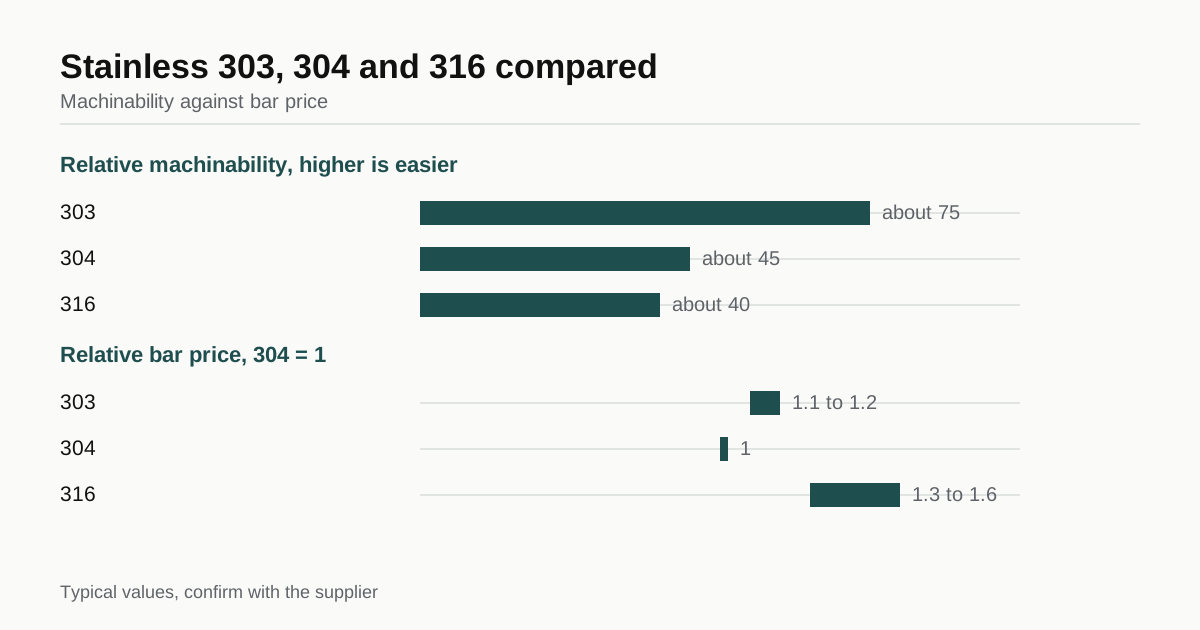
| Machinability (relative) | Good, about 75 percent | Fair, about 45 percent | Fair, about 40 percent |
| Corrosion resistance | Fair | Good | Very good, especially chlorides |
| Weldability | Poor | Good | Good |
| Relative bar price | 1.1 to 1.2 | 1 | 1.3 to 1.6 |
| Typical use | Screws, fittings, shafts | General parts, food equipment | Marine, medical, chemical |
Machinability is shown against a free-machining steel reference, and the percentages are typical for comparison. Prices vary by market and bar size.
Machinability: why 303 saves money
304 and 316 work harden. When the tool rubs instead of cutting, the surface becomes harder and the next pass wears the tool faster. Shops machine them with sharp inserts, positive geometry, steady feed and plenty of coolant. They cannot let the tool dwell or take light finishing cuts that rub. Chips are long and stringy, which causes trouble inside holes and on lathes.
303 breaks its chip because of the sulfur. The tool runs faster and lasts longer, and the surface finish is better. For small turned parts such as pins, bushings, fittings and fasteners, a cycle time 20 to 40 percent shorter than 304 is common. That saving often outweighs the higher cost of the bar.
The trade-off is corrosion and welding. The sulfur inclusions are the starting point for pitting in wet or salty conditions, and they cause hot cracking when welded. So 303 suits dry indoor parts and parts that are machined and never welded. The materials guide places these grades among the other choices.
Corrosion: when 316 is worth the premium
The chromium in all three grades forms a thin passive layer that resists rust. Chlorides break this layer down. Sea air, swimming pool chemicals, de-icing salt, bleach and body fluids all contain chlorides. 316 resists pitting better than 304 because of its molybdenum, and 304 resists it better than 303.
A rough comparison uses the pitting resistance equivalent number, which is about 18 to 20 for 304 and about 24 to 26 for 316. A higher number means better resistance. In dry indoor service all three grades are fine. In food processing with washdown, 304 is common. In marine and chemical service, medical devices and pharmaceutical equipment, 316 or 316L is the normal choice.
Passivation helps all three grades. It removes free iron left on the surface by cutting tools so the passive layer forms evenly. State the requirement on the drawing, for example passivation to ASTM A967. Note that passivation does not change dimensions, as described in the surface finish guide.
What shops do differently for each grade
Knowing how the shop treats each grade helps you read the quote. With 303 the shop runs standard carbide inserts at higher cutting speeds and uses a light coolant flow. With 304 and 316 it chooses sharp, positive inserts with a chip breaker, holds a steady feed so the tool never rubs, and floods the cut with coolant to carry heat away. Drilling deep holes in 316 needs peck cycles or through-tool coolant, otherwise chips pack in the flutes and break the drill.
Thread cutting is another point. Austenitic grades tend to gall, which means the thread surface tears and the screw seizes. Shops use sharp taps with the right lubricant or thread mills for blind holes. If your design has fine threads in 316 that are assembled and removed often, consider a different pairing, for example a 316 bolt in a 304 nut with anti-seize, because identical grades in contact are the most likely to gall. The thread callouts guide lists what to write for the thread itself.
All of this is normal shop knowledge. It is also the reason a 316 part takes longer to quote than a 303 part of the same shape.
Magnetism and why it surprises buyers
Austenitic stainless is non-magnetic when annealed. Cold work, including heavy machining and bending, can make a small amount of the structure magnetic, so a magnet may stick weakly to a 304 or 316 part. This does not mean the material is wrong. A strong attraction, on the other hand, can mean a different grade such as a 400 series steel. If magnetic behaviour matters, state it on the drawing. A test by magnet is not proof of grade.
Grade names across standards
Drawings from different regions use different names. The same grade may appear as:
| US (AISI) | EN number | EN name | Japan (JIS) |
|---|---|---|---|
| 303 | 1.4305 | X8CrNiS18-9 | SUS303 |
| 304 | 1.4301 | X5CrNi18-10 | SUS304 |
| 304L | 1.4307 | X2CrNi18-9 | SUS304L |
| 316 | 1.4401 | X5CrNiMo17-12-2 | SUS316 |
| 316L | 1.4404 | X2CrNiMo17-12-2 | SUS316L |
Write the name used on your product documents and add the equivalent in brackets. The grade equivalents guide covers this and the traps in it.
Other stainless grades you may meet
Drawings sometimes name grades outside the three above. 304L and 316L are low-carbon versions for welding, and 316L is the usual choice for medical and pharmaceutical parts. 17-4 PH is a precipitation hardening grade that reaches high strength after heat treatment and is used for shafts, valve parts and instruments. 410 and 420 are martensitic grades that can be hardened for knives, pins and wear parts, with weaker corrosion resistance. 2205 duplex has about twice the strength of 304 and good chloride resistance, though it machines slowly. Each of these has its own cost and machining notes, so name the grade on the drawing and ask the shop to confirm it can source the bar.
Bar supply and certificates in Vietnam
Bar supply and certificates in Vietnam
Stainless bar is stocked widely in Vietnam, and much of it is imported from Asian mills. Quality varies between suppliers. Two practical steps protect you:
- Ask for a mill test certificate that shows chemistry and mechanical properties for the lot, not a generic certificate
- If the part is critical, ask whether the shop will run a positive material identification check with a handheld analyser before cutting
For medical and food contact parts, state the grade, the form and the heat lot requirement in the order. The mill test certificate guide lists the details to verify on the document.
How to choose
Ask three questions:
- Will the part see chlorides or wet conditions? If yes, use 316 or 316L. If it is dry and indoors, go on.
- Will it be welded? If yes, use 304L or 316L. If no, go on.
- Is it a small turned or milled part made in volume? If yes, 303 is usually cheapest and machines best. If no, 304 is the neutral default.
A quick note on fasteners and shafts: 303 is common for parts that never touch salt or acid. For parts that do, even a small pin, use 304 or 316.
What to write on the drawing
- The grade with the standard name, for example 316L (EN 1.4404)
- The product form and condition, for example annealed bar
- Passivation requirement and standard
- Surface finish and any electropolish
- Certificate requirement, for example mill test certificate per EN 10204 type 3.1
EN 10204 defines the types of inspection documents, and type 3.1 is a certificate issued by the manufacturer’s inspection department. Asking for it by name avoids a generic letter.
Summary checklist
- Choose 303 for dry, machined-only parts in volume
- Choose 304 or 304L as the neutral default and for welded parts
- Choose 316 or 316L for chlorides, marine and medical use
- Write the grade with its standard and an equivalent
- Add passivation if corrosion matters
- Ask for the mill certificate and consider a material check
Put the grade and certificate lines on the drawing and send the RFQ. Up to three shops in Vietnam will quote your chosen grade, and you can ask each for the alternative to compare the price. We reply within 24 business hours.
Frequently asked questions
Why is 303 stainless cheaper to machine than 304?
303 contains added sulfur, which breaks the chip into short pieces and lets the tool run faster with less wear. A 303 part can have a cycle time 20 to 40 percent shorter than the same part in 304, so even with a slightly higher bar price the part often costs less.
Can I weld 303 stainless steel?
It is not recommended. The sulfur that helps machining causes hot cracking in the weld. If a part must be welded, use 304, 304L or 316L. If it must be both machined heavily and welded, discuss the design with the shop.
When do I need 316 instead of 304?
Choose 316 when the part sees chlorides, such as sea air, salt water, de-icing salt, cleaning chemicals with chloride or body fluids. The molybdenum in 316 improves resistance to pitting. For indoor dry service, 304 is usually enough.
Need a quote for a part like this?
Send the drawing. We shortlist up to 3 machine shops in Vietnam, manage the order if you want us to and reply within 24 business hours.
Send my RFQ