Material Grade Equivalents: Matching ASTM, EN and JIS Names to What a Shop Buys
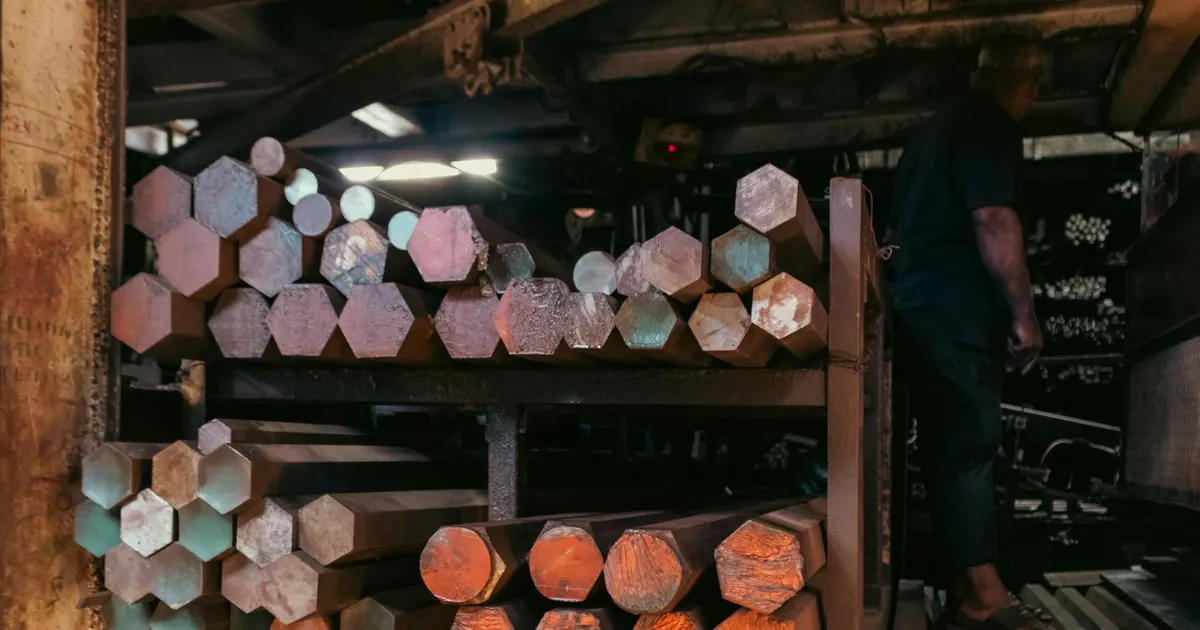
A drawing from Germany says 42CrMo4. A drawing from the United States says 4140. A drawing from Japan says SCM440. These three names describe nearly the same alloy steel, and a shop in Vietnam handles all three every week, because bar arrives from many countries and mills. The risk is not that the shop cannot read your grade. The risk is that “nearly the same” hides a difference you cared about.
Why equivalents are never exact
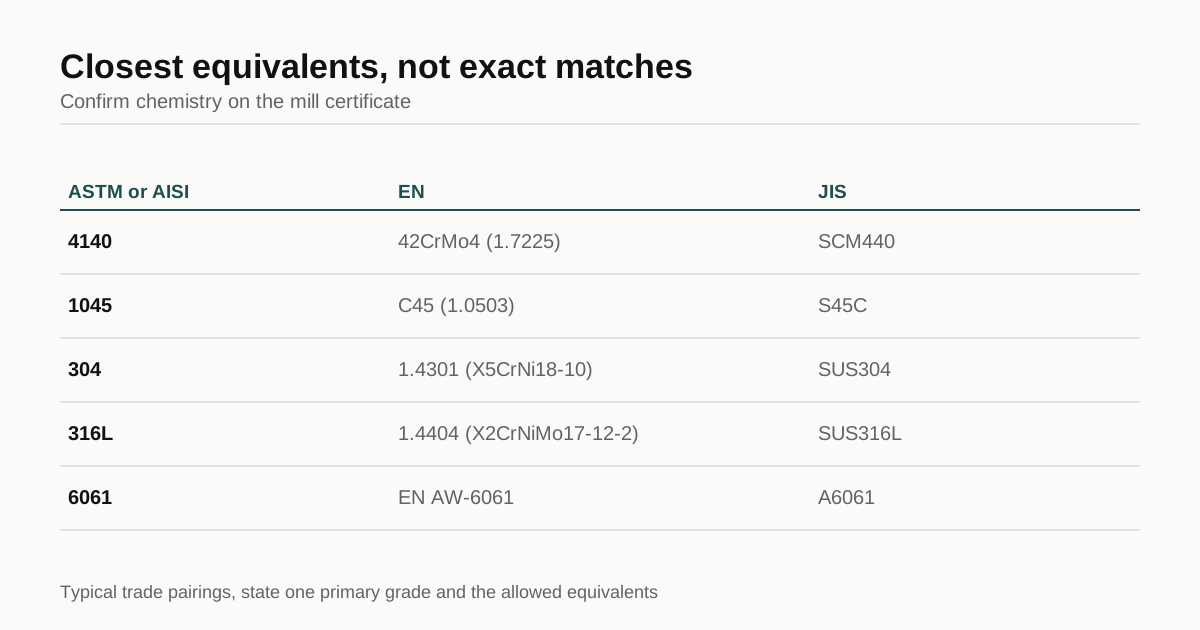
Each standard body writes its own limits. ASTM and SAE describe grades by composition ranges and, for some products, by mechanical properties. EN standards define the steel name from its composition and add rules on cleanliness and delivery condition. JIS limits differ slightly in the allowed carbon, manganese, chromium or sulfur. A grade that passes one standard may be a fraction outside another.
For most machined parts this does not matter. For parts that are heat treated to a hardness target, welded, or loaded near their limit, small differences in carbon or alloy content change the result. That is why a good drawing gives one primary grade and states whether substitution is allowed.
Common steel equivalents
| Description | ASTM or AISI | EN | JIS | Chinese GB (common) |
|---|---|---|---|---|
| Structural mild steel | A36 | S235JR (1.0038) | SS400 | Q235 |
| Medium carbon steel | 1045 | C45 (1.0503) | S45C | 45 |
| Chromium-molybdenum steel | 4140 | 42CrMo4 (1.7225) | SCM440 | 42CrMo |
| Nickel-chromium-molybdenum steel | 4340 | 34CrNiMo6 (1.6582) | SNCM439 | 40CrNiMoA |
| Cold work tool steel | D2 | X153CrMoV12 (1.2379) | SKD11 | Cr12Mo1V1 |
| Hot work tool steel | H13 | X40CrMoV5-1 (1.2344) | SKD61 | 4Cr5MoSiV1 |
These are the usual pairings in trade catalogues. Some are very close, such as 4140 and 42CrMo4, and some are approximate, such as 4340 and its European and Japanese neighbours. If your design relies on hardenability or toughness, ask the shop to supply the mill certificate and compare the actual chemistry with your limits. The 4140 and 4340 guide shows which properties to check.
Stainless, aluminium and copper alloys
| Description | ASTM, AISI or UNS | EN | JIS |
|---|---|---|---|
| Free-machining stainless | 303 | 1.4305 (X8CrNiS18-9) | SUS303 |
| General stainless | 304 | 1.4301 (X5CrNi18-10) | SUS304 |
| Marine stainless | 316 | 1.4401 (X5CrNiMo17-12-2) | SUS316 |
| 6061 aluminium | 6061 (A96061) | EN AW-6061 | A6061 |
| 7075 aluminium | 7075 (A97075) | EN AW-7075 | A7075 |
| 5052 aluminium | 5052 | EN AW-5052 | A5052 |
| Free-cutting brass | C36000 | CW614N (CuZn39Pb3) | C3604 |
| Pure copper | C11000 | CW004A (Cu-ETP) | C1100 |
For aluminium, the numbers are the same in most systems because the four-digit scheme is international. What changes is the temper and the product form, so write them out. The 6061 and 7075 guide covers tempers. Stainless grades are explained in the stainless guide.
What happens in a shop in Vietnam
Vietnamese shops buy bar from several sources. Local distributors stock Asian mill material, and certified bar from European, Japanese and Korean mills is available on order. The mill certificate lists the standard the material was made to, for example JIS G4053 for SCM440, and a shop’s job is to match your drawing’s grade to something it can buy that meets your limits.
Three situations come up often:
- The shop quotes the grade you wrote and buys exactly that. Good, if the lot has a certificate.
- The shop proposes an equivalent from stock. Good if your drawing allowed it and the certificate confirms the chemistry.
- The shop uses a local trade name or a no-name bar. Not acceptable for any part that matters, so ask for the certificate before cutting.
A shop that buys from a stockist may not know the full origin of the bar. For critical parts ask the shop to name the mill and show the certificate. The mill test certificate guide explains how to read it.
Local standards and trade names
Vietnam has its own national standards, written TCVN, and some local distributors still sell steel by those names or by a mill brand. Chinese GB grades such as 45 or 42CrMo are also common because much of the bar passes through the regional trade. None of this is a problem when the certificate states the grade and standard. It becomes a problem when a bar arrives with only a paint mark and a handwritten label.
Be careful with the grades that look the same and are not. SS400 is a structural steel with no strict carbon limit, so it should not replace S45C in a part that needs hardness. A grade written only as “45 steel” could be a Chinese 45 or a Japanese S45C, close but with different residual element limits. Stainless 304 can arrive as 304, 304L or a dual-certified bar, and the carbon content decides whether it may be welded. The cure in each case is the same: name the standard on the drawing and read the certificate.
How to write the grade on the drawing
Use this pattern:
- Primary grade: the grade and standard, for example “Alloy steel 42CrMo4 to EN 10083-3”
- Delivery condition: annealed, quenched and tempered, normalised or as drawn
- Acceptable equivalents: “AISI 4140 and JIS SCM440 acceptable” or “No substitution”
- Certificate: “Mill certificate required, EN 10204 type 3.1”
The EN 10204 standard defines the types of inspection documents, and type 3.1 is a certificate issued by the manufacturer’s own inspection representative, independent of production. A shop can supply it when the mill provides it with the bar.
Avoid vague phrases such as “stainless steel”, “alloy steel” or “aluminium”. They lead to quotes based on the cheapest option, which may not be the one you meant.
Checking what you received
After the parts arrive, a few quick checks confirm that the grade is plausible. A hardness reading on a finished part tells you whether the condition matches the drawing. A magnet and a spark test separate carbon steel from austenitic stainless at a rough level. A handheld XRF analyser identifies the alloy family within seconds, though it cannot read carbon, so it cannot tell S45C from a mild steel or 304 from 304L. For a high-value part or a regulated product, a laboratory analysis of one sample from the lot costs little compared with the value at risk, and it settles any dispute about the bar.
Keep the certificate and the test result together with the order record. If a customer queries the material years later, one folder answers the question.
Delivery condition matters as much as the grade
The same grade behaves differently by condition. 42CrMo4 delivered annealed machines easily and can be heat treated later. The same steel delivered quenched and tempered at 28 to 32 HRC is harder to cut, and does not need heat treatment. 1045 delivered normalised differs from cold-drawn 1045. If you leave the condition off the drawing, the shop picks the cheapest or the one it holds.
For stainless, “annealed” and “cold worked” bar differ in strength and in size tolerance. For aluminium, the temper decides strength and stability. Always add the condition.
When to say no substitution
Write a strict call-out when:
- The part will be heat treated to a specified hardness and depth
- The part will be welded and the weld procedure depends on chemistry
- The part is in a regulated product where the material record is part of your file
- The design is at the limit of strength
- A customer or standard names the grade
Otherwise, allowing equivalents widens the shop’s choice of stock and often shortens delivery. The lead time guide shows how waiting for bar adds days.
A sample drawing note
Putting all of this together, a complete material note might read:
“Material: alloy steel 42CrMo4 to EN 10083-3, annealed, round bar. AISI 4140 and JIS SCM440 acceptable. Mill certificate EN 10204 type 3.1 required, with heat number marked on the packing list.”
That is four lines of text and removes the most common questions a shop would ask. If you add the heat treatment requirement, such as quench and temper to 28 to 32 HRC, state who performs it and who checks the hardness. For a second order, add “same heat lot as order 1 if available”, which helps when consistency between batches matters.
Summary checklist
- Write one primary grade with its standard name
- Add the delivery condition or temper
- List acceptable equivalents or write no substitution
- Request a mill certificate that names the standard
- Ask the shop to state the grade it will buy in the quote
- Check the certificate against your limits on receipt
When the grade, condition and certificate are on the drawing, send the RFQ. Up to three shops in Vietnam will each name the material they plan to buy, and we reply within 24 business hours.
See also: importing machined parts from Vietnam into Japan, with JIS drawing and material habits.
Frequently asked questions
Are material grade equivalents exact matches?
No. An equivalent is the closest grade in another standard, and the chemistry limits, mechanical property requirements and test methods can differ. Treat the table as a starting point and confirm on the mill certificate that the lot meets the limits your drawing requires.
What should I write if I do not mind which equivalent the shop uses?
Name one primary grade and add a short list of acceptable equivalents, for example 42CrMo4 (AISI 4140, JIS SCM440), or write no substitution allowed if the design depends on it. Without a statement, the shop picks what it can buy fastest.
Which standard do shops in Vietnam use?
Shops work with all of them. Bar is imported from several countries, so a shop may hold material certified to JIS, GB, EN, ASTM or KS. The shop's job is to match your grade to what is available, and yours is to say what is acceptable.
Need a quote for a part like this?
Send the drawing. We shortlist up to 3 machine shops in Vietnam, manage the order if you want us to and reply within 24 business hours.
Send my RFQ