6061 or 7075 Aluminium: Choosing the Alloy for a Machined Part
Both alloys are aluminium, both machine cleanly and both look the same as a blank. The difference shows when the part is loaded, welded, coated or left outside. Choosing between 6061 and 7075 comes down to four questions: how strong must the part be, does it need welding, where will it live and what is the budget. This guide answers each one with typical figures.
What the numbers say
6061 is an aluminium alloy with magnesium and silicon as the main additions. 7075 uses zinc, magnesium and copper, which is why it reaches strengths close to some steels. The designations in other systems are EN AW-6061 and EN AW-7075, and A96061 and A97075 in the UNS system.
| Property (typical, T6 temper) | 6061-T6 | 7075-T6 |
|---|---|---|
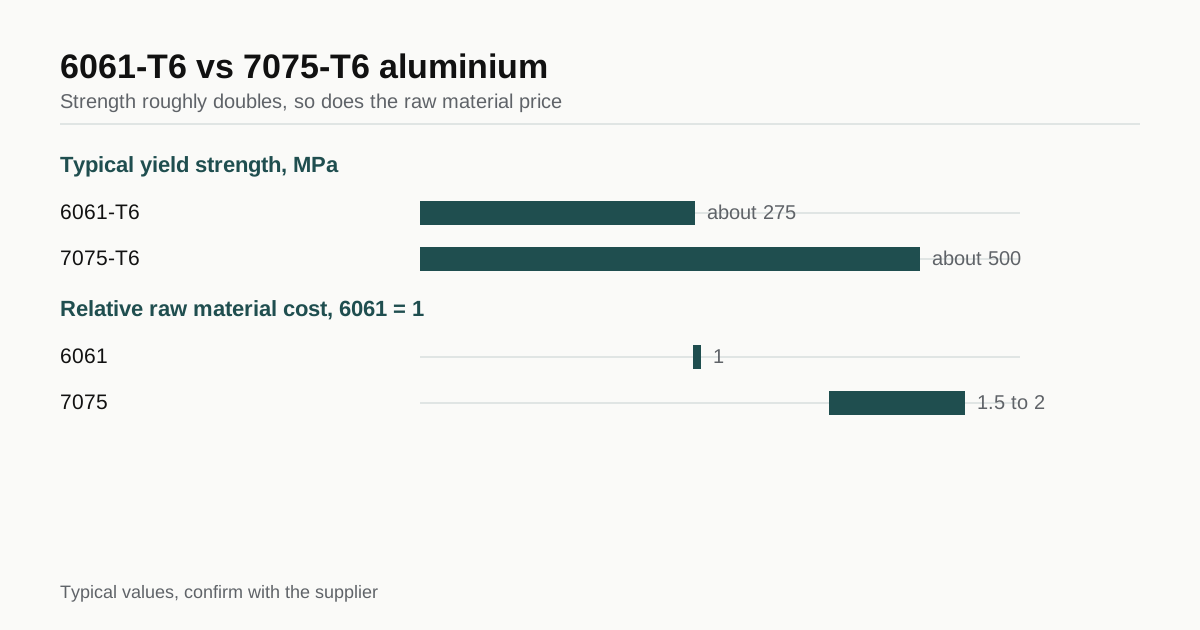
| Yield strength | About 275 MPa | About 500 MPa |
| Tensile strength | About 310 MPa | About 570 MPa |
| Density | 2.70 g/cm3 | 2.81 g/cm3 |
| Hardness (Brinell) | About 95 | About 150 |
| Corrosion resistance | Good | Fair, needs protection |
| Weldability (fusion) | Good | Poor, not recommended |
| Anodizing response | Very good | Good |
| Relative raw material cost | 1 | About 1.5 to 2 |
These are typical values from published data. Real plates differ by supplier and temper, so request the mill certificate for the lot you buy. The mill test certificate guide explains how to check it.
Strength: when 7075 earns its price
Because 7075-T6 has nearly double the yield strength, a part can be lighter for the same load. A bracket in 6061 that needs a 6 mm wall may work with a 4 mm wall in 7075. In weight-sensitive products such as robot arms, camera gimbals, bicycle components and structural frames, the saved mass can justify the higher material cost.
But strength is not the only measure. Stiffness, the resistance to bending, is almost the same for both alloys because both have a modulus of elasticity of about 70 GPa. If the part fails by flexing under load and not by breaking, switching to 7075 changes nothing. Check which behaviour matters before you pay more.
Fatigue strength is higher for 7075 in general, though it is notch sensitive: a sharp internal corner or a poor surface finish lowers it quickly. If the part sees repeated loading, ask your engineer to check the stress concentration, then consider a larger radius.
Corrosion and coatings
6061 has good general corrosion resistance and stays serviceable outdoors with only a clear anodize. 7075-T6 is more prone to corrosion and in some conditions to stress corrosion cracking, especially in the short transverse direction of thick plate. Over-aged tempers such as T73 improve this at some cost in strength, and they are used where cracking is a known risk.
For 7075 parts in humid or marine air, specify a coating. Anodizing is the usual choice. Coating choices and dimensional growth are covered in the surface finish guide and the anodizing guide. Both alloys accept hard anodize, though a 7075 part needs closer process control to avoid soft spots or burning at sharp edges.
Welding and forming
6061 welds well with common filler wires and then regains much of its strength after heat treatment. 7075 cracks when fusion welded, so assemblies in 7075 are bolted, riveted, bonded or joined by friction methods. If a part must be welded, choose 6061. If the design mixes machined and welded parts, the weld joint often decides the alloy.
Bending is also easier in 6061. 7075 in the T6 temper cracks when bent sharply, so formed parts should be made in 6061 or in a softer temper of 7075.
Machinability
Both alloys machine well, and 7075 is a little more rigid, giving a clean finish with sharp tools and less burr. It can wear tools slightly faster because of its hardness. In practice a shop quotes the same cycle time for both alloys for most parts, and the main difference in the quote is material cost.
One practical point is internal stress. Plates in the T651 temper are stress relieved by stretching, and this is the form to buy for parts that must stay flat after heavy machining. Specify 6061-T651 or 7075-T651 for plate, and T6511 for extruded bar, as the shop may default to T6 without stress relief if the drawing says only “6061”.
Cost and availability
Raw material for 7075 typically costs about one and a half to two times the price of 6061, and the price gap changes with the market. For a part that is mostly machined away from a solid block, material can be 20 to 40 percent of the unit price, so the alloy choice can move the total noticeably. For a small part where machining time dominates, the cost difference is small.
Availability differs too. 6061 is stocked in plate, round, flat and extrusions in many sizes. 7075 is available in plate and round bar, but a shop may need to order an unusual thickness from a distributor, which adds days. Ask the shop what it holds, and consider a stock thickness for the design if the schedule is tight. The lead time guide shows how material waiting time affects delivery.
A quick cost example
Take a 120 by 80 by 25 mm block that is machined from a 130 by 90 by 30 mm blank. The blank weighs about 0.95 kg. At an aluminium plate price of USD 5 per kilogram for 6061, material comes to about USD 4.75 per part, and at roughly 1.7 times that price for 7075 it comes to about USD 8. The difference of about USD 3.25 per part is small against a machining price of USD 25 to 40. For a part cut from a large 300 mm plate where 90 percent of the block becomes chips, the same difference grows to several times that amount, and it matters more than the cutting time.
Material price per kilogram changes with the market and with the plate thickness, so treat these figures as an illustration of how to think, not as a quote. Ask the shop to show material as a separate line so you can see how much of the price depends on the alloy. The quote breakdown guide explains the other lines.
Equivalent grades
If your design came from Europe or Japan, you may see different names. 6061 corresponds to EN AW-6061 and to A6061 in Japanese JIS designation. 6082 is a European alloy often used in place of 6061 and is similar though not identical, with slightly higher strength in the T6 temper. 7075 corresponds to EN AW-7075 and to A7075 in JIS. The grade equivalents guide explains how to write the grade so that a shop buys the right material.
When 6061 is the right default
Use 6061 for:
- Enclosures, covers and brackets with moderate loads
- Parts that need welding or forming
- Parts that will live outdoors with a clear anodize
- Cost-sensitive volumes and general-purpose fixtures
- Housings and heat sinks where thermal conductivity matters
6061 has thermal conductivity of about 167 W per metre kelvin, a little higher than 7075 at about 130, so it helps in heat sinks too.
When 7075 is the right choice
Use 7075 for:
- Structural parts where weight is critical
- Parts under repeated high load
- Tooling plates and fixtures that must resist wear and bending
- Moving parts like gears or cams, where hardness helps
If you are unsure, send both options to the shop and ask for a price on each. The difference in the quote tells you whether the stronger alloy is a real cost.
Notes that prevent surprises
Two drawing notes save a lot of back and forth. First, write the full material call-out, such as “Aluminium 6061-T651 plate, EN AW-6061”, not only “aluminium”. A shop reading “aluminium” may quote 6061, 6082 or a cheaper unspecified alloy, and each behaves differently. Second, tell the shop whether a substitution is acceptable. If you allow 6082 in place of 6061 or 7050 in place of 7075, say so in writing, since the shop may find a better price or faster delivery with an equivalent grade.
Finally, think about where the part will be inspected. A 7075 part that is anodized and then sits in a humid warehouse for weeks before assembly can show white spots at sharp edges if the sealing step was weak. A short note asking for sealed anodize and dry packaging costs nothing.
Summary checklist
- Decide whether strength, stiffness or weight is the limiting factor
- Choose 6061 if the part needs welding, bending or bulk cost reduction
- Choose 7075 if the part needs strength in a bolted or one-piece design
- State the temper on the drawing, for example T651 for plate
- Specify the coating for 7075 parts in humid air
- Ask the shop which stock sizes it holds
- Request the mill certificate for the lot
When the alloy and temper are on the drawing, send the RFQ and ask for both options if you are unsure. Up to three shops in Vietnam will quote each version, and we reply within 24 business hours.
Frequently asked questions
Is 7075 aluminium always stronger than 6061?
In the common T6 temper, yes. Typical yield strength is about 500 MPa for 7075-T6 and about 275 MPa for 6061-T6, so 7075 is nearly twice as strong. The price is lower corrosion resistance, poor weldability and a higher raw material cost.
Can 7075 be anodized like 6061?
Yes, both anodize well. The colour and tone can differ slightly in the same dye bath, and 7075 is more sensitive to process control in hard anodizing. If parts of both alloys sit side by side in an assembly, ask for a sample.
Which alloy is easier to find in Vietnam?
Both are available, but 6061 is stocked in more shapes and sizes and ships from stock more often. 7075 is usually available in plate and round bar, and odd sizes can add days to the lead time. Ask the shop what it holds before you fix the alloy on the drawing.
Need a quote for a part like this?
Send the drawing. We shortlist up to 3 machine shops in Vietnam, manage the order if you want us to and reply within 24 business hours.
Send my RFQ