Anodizing and Plating for Machined Parts: Who Does the Work in Vietnam
Finishing is where many first-time buyers lose weeks. The part is machined on time, then it waits for a finisher that the machine shop did not mention in the quote. In Vietnam the pattern is common and manageable once you know it: most shops machine, and a specialised neighbour anodizes or plates. This guide explains how that works, what to put on the drawing and how to avoid a dimensional surprise.
How the work is usually arranged
A CNC shop and a finishing shop are different businesses with different equipment. Anodizing needs tanks, rectifiers, wastewater treatment and a licence for chemical handling, so it concentrates in industrial zones. Machine shops around Ho Chi Minh City, Binh Duong, Dong Nai and the Hanoi region typically rely on finishers in or near the same industrial areas.
Three arrangements exist:
- Shop manages the finisher. The machine shop sends the parts out, receives them back, inspects them and ships. You deal with one party. This is the most common setup and the one to prefer on a first order.
- Shop has an in-house line. Rare and usually limited to certain finishes. Schedule control is better.
- Buyer names the finisher. Possible when your company already works with a specific finisher or has a corporate approved list. The machine shop then delivers parts to that finisher and the lead time and responsibility need to be clear in writing.
If the quote does not say who finishes the parts, ask. The answer affects both the schedule and who is liable if the coating fails.
What anodizing does and what it does not
Anodizing is an electrochemical process that thickens the natural oxide layer on aluminium. It is not a paint. The layer is part of the surface, hard and porous, and it takes dye well. Titanium and magnesium can be anodized too, but most orders concern aluminium.
The common types are:
- Type II (sulfuric acid): the standard decorative and corrosion-protective finish, clear or dyed
- Type III (hard anodize): thicker and harder, used for wear surfaces, sliding parts and heavier duty
- Type I (chromic acid): thin, rare and restricted in some markets
The defining US military specification is MIL-A-8625, and ISO 7599 covers anodizing of aluminium in the international system. Cite one of them on the drawing so the finisher knows which type, class and sealing you mean.
Typical numbers
| Finish | Base metal | Typical thickness | Dimensional effect | Notes |
|---|---|---|---|---|
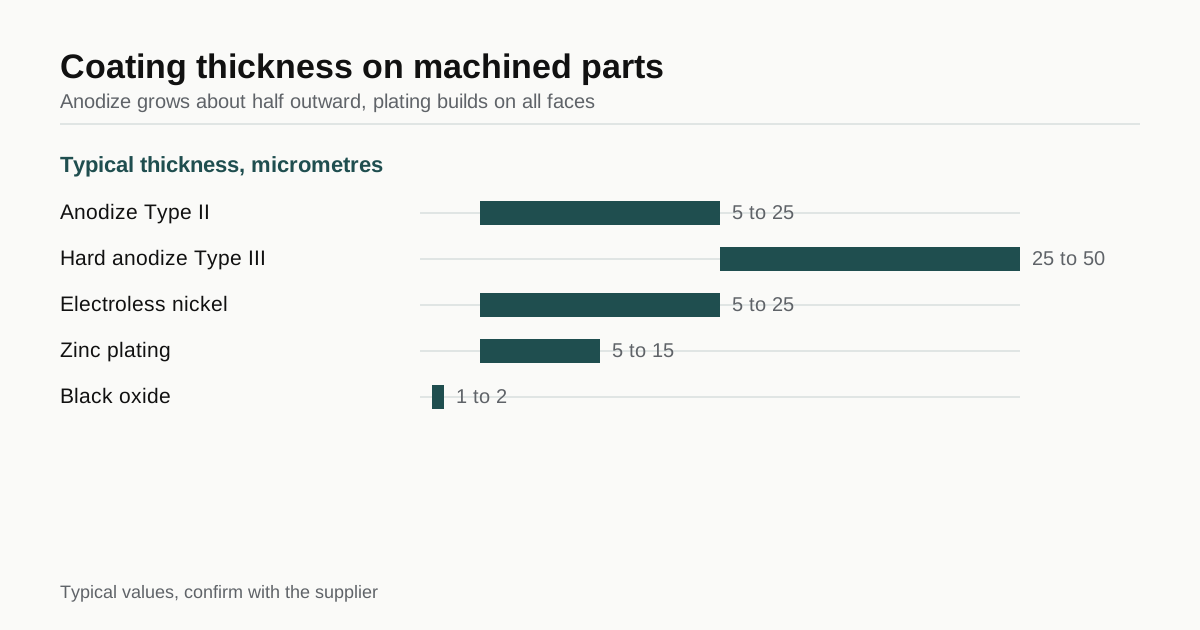
| Anodize Type II clear | Aluminium | 5 to 25 micrometres | About half of the thickness grows outward | Standard finish, good repeatability |
| Anodize Type II black | Aluminium | 10 to 25 micrometres | Same as above | Popular for enclosures and optical parts |
| Hard anodize Type III | Aluminium | 25 to 50 micrometres | Larger growth, tolerance planning needed | Wear surface, less colour choice |
| Electroless nickel | Steel, aluminium | 5 to 25 micrometres | Builds up on all faces evenly | Hardness and corrosion resistance |
| Zinc plating | Steel | 5 to 15 micrometres | Builds up on threads too | Corrosion protection, clear or yellow |
| Black oxide | Steel | 1 to 2 micrometres | Almost none | Appearance and light protection |
| Passivation | Stainless steel | None measurable | None | Chemical cleaning step, not a coating |
These figures are typical and the finisher confirms the exact result. The same table in the surface finish guide explains Ra values and how a coating relates to the machined finish below it.
The dimensional growth problem
Because about half of an anodic layer grows outward, a 20 micrometre layer adds about 10 micrometres to each surface. On a shaft that gains 10 micrometres on its radius, the diameter grows by about 20 micrometres. A bore shrinks by the same amount. A press fit or a bearing seat can be ruined by that change.
There are three ways to handle it, and the drawing should name one:
- Mask the feature so it stays bare. Typical for bearing bores, pins and threads.
- Machine to a pre-coat size so the final dimension lands in tolerance after anodizing. State the final size and let the shop decide the pre-coat size, or give the pre-coat size yourself.
- Machine after anodizing for a critical bore. This removes the coating there, which can reduce corrosion protection.
Threads need special care. A coating on a tight thread class can stop a screw from entering. Most shops mask threaded holes, or chase them after coating. Say which one you want.
Electrical contact and rack marks
During anodizing the part hangs from a rack by a contact point that stays bare. Every part has a small unanodized mark where the rack touched. If the contact point matters visually, mark an area on the drawing where the mark is acceptable, for example inside a hole or on a hidden face. If you need electrical grounding, the bare spot is useful, and a bare face can be called out deliberately.
Alloy, surface and colour
The result depends on the alloy. The 6061 grade anodizes evenly in clear and dyed finishes. Alloys with high copper, such as 2024, or with high silicon, such as many castings, tend to turn greyish or patchy. The 7075 grade anodizes well but often shows a slightly different tone from 6061 in the same dye bath. If one assembly mixes alloys, expect a colour difference and ask for a sample.
Machining marks show through anodizing. A part that looks acceptable as machined may show tool lines after a clear or black layer. A bead blast before anodizing gives a uniform matte look and hides small scratches. If cosmetic quality matters, say so and state the pre-treatment, for example bead blast followed by clear anodize.
Sealing, dyeing and the details that change the result
Anodic layers are porous. After anodizing, the finisher either dyes the layer, which fills the pores with colour, or leaves it clear, then seals it. Sealing closes the pores in hot water or in a nickel acetate bath and improves corrosion resistance and colour stability. A part that is dyed and not sealed fades quickly and stains. A drawing that says only “anodize black” leaves the sealing step to the finisher, so state it: “Type II, black, sealed.”
Hard anodize is often left unsealed or sealed lightly, because sealing softens the surface a little. If you need wear resistance, say so, and let the finisher decide the sealing. Also note that very sharp edges can burn during hard anodizing, so a small edge break of 0.2 to 0.3 mm on the part helps the coating and helps the shop. The deburring guide shows how to write it.
Plating on steel and copper alloys
Electroless nickel gives an even layer on complex shapes, including inside bores, because it needs no current. Electrolytic zinc builds thicker on edges and corners than in recesses, which matters for threads. Zinc and cadmium alternatives are chosen by corrosion needs, and chromate treatments after zinc come in clear, yellow and black. Ask which chromate the finisher uses and whether it is free of hexavalent chromium if your market restricts it. Salt spray resistance is quoted in hours to first white rust, for example 72 hours for clear zinc, though the actual figure depends on thickness and passivation. A request for a salt spray test, tested to ASTM B117, adds cost and time and belongs in the order only when it matters.
Checks that protect you
Checks that protect you
Ask the shop to include, with every anodized or plated lot:
- A certificate of conformance that names the specification and class
- A thickness measurement on a sample of parts, in micrometres
- The colour or dye reference for dyed finishes
- Photographs of the parts before packing
For parts going to Europe or the United States, ask the finisher about restricted substances. Hexavalent chromium and some older plating processes are restricted under RoHS and REACH. Finishers who export regularly know the rules, and the answer should come without delay. The quality documents guide lists the usual paperwork.
Lead time and packing
Finishing adds time because the parts move out and come back. A typical anodize adds three to seven working days to a lot. Plating can add a similar amount. Hard anodize may need more time. Factor this into the schedule and cross-check with the lead time guide.
Finished parts need protection. Anodized and plated surfaces scratch, and parts that touch each other on the way can arrive marked. Ask for individual bags, foam or dividers. The export packing guide covers how to specify this.
Checklist for the RFQ
- Name the finish and specification, for example anodize Type II clear to MIL-A-8625 or ISO 7599
- State the thickness range, if it matters
- Mark masked features and threads on the drawing
- Say which faces can carry a rack mark
- State the colour and whether a master sample exists
- Ask who performs the finishing and for a certificate of conformance
- Allow extra time in the delivery schedule
Put those notes on the drawing and send the RFQ. Up to three shops in Vietnam will each name their finisher and their lead time, and we reply within 24 business hours.
Frequently asked questions
Do machine shops in Vietnam anodize parts themselves?
Most CNC shops do not run their own anodizing line. They send parts to a specialised finishing shop nearby and manage the transport and inspection. A few larger shops have in-house lines. Ask who does the finishing and whether the finisher can be named on the quote.
How long does anodizing add to the lead time?
Typically three to seven working days for standard clear or black anodizing, depending on the finisher's queue and batch size. Hard anodizing and special colours can take longer. State the finish in the RFQ so the schedule includes it.
Will the colour match between batches?
Clear and black anodizing are the most repeatable. Other dyed colours can shift slightly from batch to batch and between alloys. If colour matters, ask for a sample plate or approved master part and order all parts of one product from the same batch.
Need a quote for a part like this?
Send the drawing. We shortlist up to 3 machine shops in Vietnam, manage the order if you want us to and reply within 24 business hours.
Send my RFQ