POM, PEEK and Nylon: Choosing an Engineering Plastic for CNC Machined Parts
Plastic parts are not metal parts cut with a softer tool. They expand with heat, absorb moisture, hold internal stress from their manufacture and distort under a clamp. A shop that machines plastic regularly handles these effects without comment. A buyer who ignores them can end up with parts that measure correctly at the shop and do not fit at the dock. This guide covers the three plastics that account for most requests and the drawing habits that keep them on size.
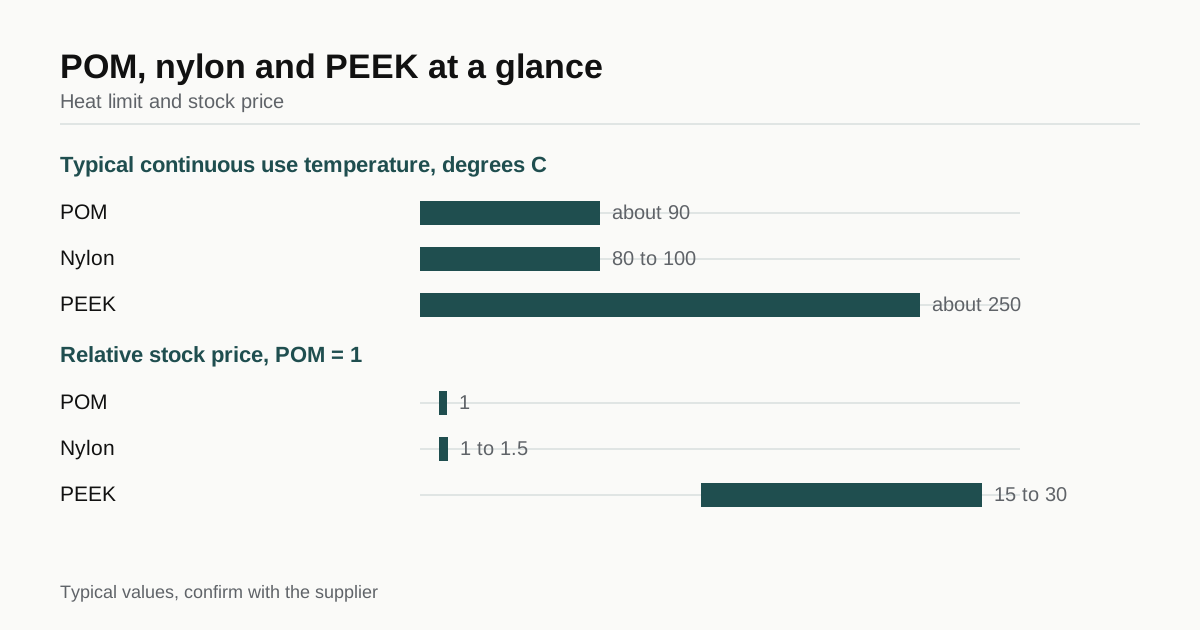
The three plastics in one table
| Property (typical) | POM (acetal) | Nylon (PA6 or PA66) | PEEK |
|---|---|---|---|
| Density | 1.41 g/cm3 | 1.14 g/cm3 | 1.31 g/cm3 |
| Continuous use temperature | About 90 degrees C | About 80 to 100 degrees C | About 250 degrees C |
| Moisture absorption | Very low, about 0.2 percent | High, 2 to 3 percent in air | Very low, about 0.5 percent |
| Machining behaviour | Excellent, clean chips | Good, but moves and burrs | Good, needs sharp tools |
| Relative stock price | 1 | 1 to 1.5 | 15 to 30 |
| Typical use | Gears, bushings, jigs, valve parts | Wear plates, rollers, bearings | Medical, semiconductor, aerospace parts |
Numbers vary with supplier and grade. The data sheet of the actual stock is the reference, and a shop should read from it before quoting a tight tolerance.
POM: the default for precision parts
POM is also sold as acetal, and as Delrin, which is a trade name. It comes as homopolymer and copolymer. Homopolymer is slightly stronger and stiffer, with a hard centre that can show a porous zone in large rods. Copolymer resists hot water, steam and chemicals better and has fewer centre-line issues. If you do not need the extra stiffness, copolymer is the safer default.
POM machines with a good surface finish and clean chips, holds tolerance and has low friction, so it is common in gears, bushings, sliding blocks, valve parts and fixtures. The limits are heat, because it softens above about 100 degrees Celsius, and strong acids and bases, which attack it. It also does not bond well with glue, so design for mechanical fixing.
Nylon: tough and wear resistant, but it moves
Nylon is tough, damps vibration and wears well against metal. PA6 and PA66 are the common types, and cast nylon (PA6G) is used for large parts and thick sections. Filled versions with molybdenum disulfide or glass fibre exist for higher wear or stiffness.
Its main weakness is moisture. Nylon absorbs water from the air, and the part grows as it does. A part machined in a dry shop in the dry season can swell by 0.2 to 0.5 percent in length once it reaches balance with humid air, which is typical of Vietnam for much of the year. For a 100 mm part this is up to 0.5 mm. If dimensional stability matters, ask for a pre-conditioned nylon, or choose POM, and state the humidity at which the part should meet the drawing.
PEEK: high temperature and chemical resistance
PEEK is a semi-crystalline high-performance plastic that works at about 250 degrees Celsius for continuous use and resists most chemicals. It is stable in size, strong and wears well, and grades with carbon or glass fibre add stiffness. It is used in semiconductor equipment, medical instruments, oil and gas parts and aerospace brackets.
It costs far more than POM, and the machining is slower and less forgiving. Sharp carbide or diamond tools, steady feed, and good chip clearance are needed to avoid melting and burrs. Because PEEK is expensive, shops quote it with a material allowance and often ask for a confirmed order before buying the rod. Use it only where heat, chemicals or purity demand it. The semiconductor guide and the medical guide explain two areas where it appears.
Why plastic needs different tolerances
Plastic expands about ten times as much as steel for each degree of temperature change. A POM part of 100 mm grows about 0.11 mm for each 10 degrees Celsius. A part measured warm from the machine reads larger than the same part after cooling. Shops with experience let parts stabilise before inspection, and they measure at a stated temperature, typically 20 degrees Celsius.
Plastic also relaxes. Internal stress locked into a rod during extrusion releases when material is cut away, and a thin part can warp hours or days after machining. Stress-relieved stock and roughing before finishing reduce the effect. Parts with large flat areas or uneven wall thickness are most at risk.
Practical tolerance advice:
- Use plus or minus 0.1 mm as the general tolerance unless the function needs better
- Call out tight tolerances only on features that need them, such as a bearing bore
- Avoid tolerances on long, thin or uneven sections
- State the measurement temperature and humidity for tight features
The tolerance guide describes how to separate critical from general features.
Machining notes a buyer should know
You do not need to program the machine, but a few facts explain the quote:
- Clamping: soft plastics deform under normal vise pressure, so shops use soft jaws, vacuum tables or custom fixtures
- Tools: sharp single-flute cutters give a clean cut and avoid heat build-up
- Coolant: many plastics machine dry or with air blast. Water-based coolant is acceptable for some, but not for nylon when moisture matters
- Threads: fine threads in plastic strip easily. Coarse threads, thread inserts or through holes with nuts hold better
- Thin walls: keep wall thickness above about 1.5 mm for POM and 2 mm for nylon where possible
Surface finish from plastic machining is usually Ra 0.8 to 3.2 micrometres. A polished or transparent look needs extra work and is a separate item on the quote. The design changes guide lists drawing changes that also reduce plastic machining cost.
A worked example of tolerance on plastic
Take a POM bushing with a 20 mm bore that must accept a 20 mm steel shaft with a sliding fit. In steel, a shop would hold the bore to plus 0.02 mm. In POM, the bushing grows about 0.022 mm in diameter for every 10 degrees Celsius over 20, and it can move more when it absorbs a little water and relaxes its stress. A bore that measures 20.02 mm at the shop may be 20.05 mm in a warm machine hall.
A better drawing gives a wider band, for example plus 0.05 / plus 0.10 mm, states that the bore is measured at 20 degrees Celsius, and leaves the clearance to the design. If the fit is critical, the shop can machine the bore slightly under size and finish it to the shaft with a reamer at assembly. Talking through such a case before the order saves a rejected lot.
Other plastics you may see
POM, nylon and PEEK are not the only choices. Others that often appear in RFQs include:
- PTFE: very low friction and wide chemical resistance, soft and creeps under load
- UHMW polyethylene: very high wear resistance and impact strength, used for liners and guides
- PC and PMMA: clear parts, which need polishing for transparency
- ABS: low cost for housings and prototypes
- PET: stable, good for food-contact and wear parts, in several grades
Each has a different cost and behaviour. State the grade, not only “plastic”, and include the colour if it matters. Natural, black and sometimes blue are standard colours of stock.
Inspection and packaging of plastic parts
Plastic parts scratch easily and carry static, so they attract dust. Shops should pack them in individual bags or in trays with dividers, never loose in a carton. For clear parts, a protective film stays on until assembly. For parts that need dimensional stability, such as nylon, pack in sealed bags with a desiccant pouch so the moisture content does not change during shipping. State these rules in the order, and see the export packing guide for further detail on moisture and cartons.
Supply in Vietnam
POM and nylon rod, tube and sheet are widely available through distributors, mostly imported. PEEK, PTFE and filled grades are imported on order, with typical delivery of one to three weeks. For parts with regulatory demands, such as food contact or medical use, ask the supplier for a grade that carries the documentation, and state the requirement on the order. Do not assume that any natural-coloured POM suits food contact.
Summary checklist
- Choose POM for precision and stability, nylon for toughness, PEEK for heat and chemicals
- Allow looser tolerances than for metal, typically plus or minus 0.1 mm
- State grade, colour and any stress-relief requirement
- For nylon, specify the humidity condition or choose another plastic
- Mark thin walls and large flat areas for discussion
- Ask for a measurement at stable temperature
When the plastic grade and tolerances are clear, send the RFQ. Up to three shops in Vietnam will quote the parts, and we reply within 24 business hours.
Frequently asked questions
Which plastic is easiest to machine to a tight tolerance?
POM, also called acetal, is the most dimensionally stable of the common engineering plastics and machines cleanly. Nylon absorbs moisture and moves more, and PEEK is stable but expensive. For tight tolerances POM is the usual first choice unless heat or chemicals rule it out.
How tight a tolerance can I expect on a machined plastic part?
A realistic general tolerance for machined plastic is plus or minus 0.1 mm, and plus or minus 0.05 mm on selected features with stable material and a controlled measuring temperature. Tolerances below that need discussion with the shop and often a second look at the design.
Why is PEEK so much more expensive than POM?
PEEK is a high-performance polymer made in small volumes. Raw stock typically costs 15 to 30 times as much as POM per kilogram. It earns the price in high temperature, chemical and wear conditions where POM would fail. For ordinary parts it is overspecified.
Need a quote for a part like this?
Send the drawing. We shortlist up to 3 machine shops in Vietnam, manage the order if you want us to and reply within 24 business hours.
Send my RFQ