Brass and Copper for CNC Parts: C360, C110 and When Lead-Free Matters
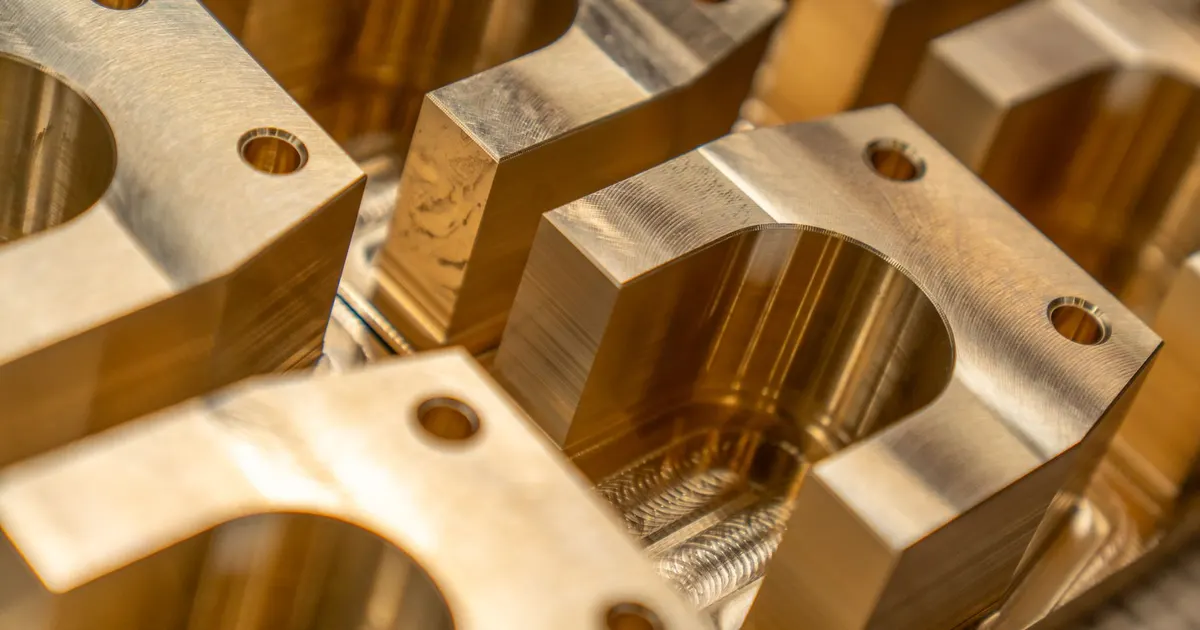
Brass and copper are the metals buyers forget to specify properly. Most drawings say only “brass” or “copper”, which covers dozens of alloys with different machinability, strength, conductivity and legal status. A drawing that names the alloy and the condition removes the guesswork, and the quote that comes back is easier to compare. This guide covers the three families that matter for CNC parts: free-cutting brass, pure copper and lead-free alternatives.
The alloys most drawings mean
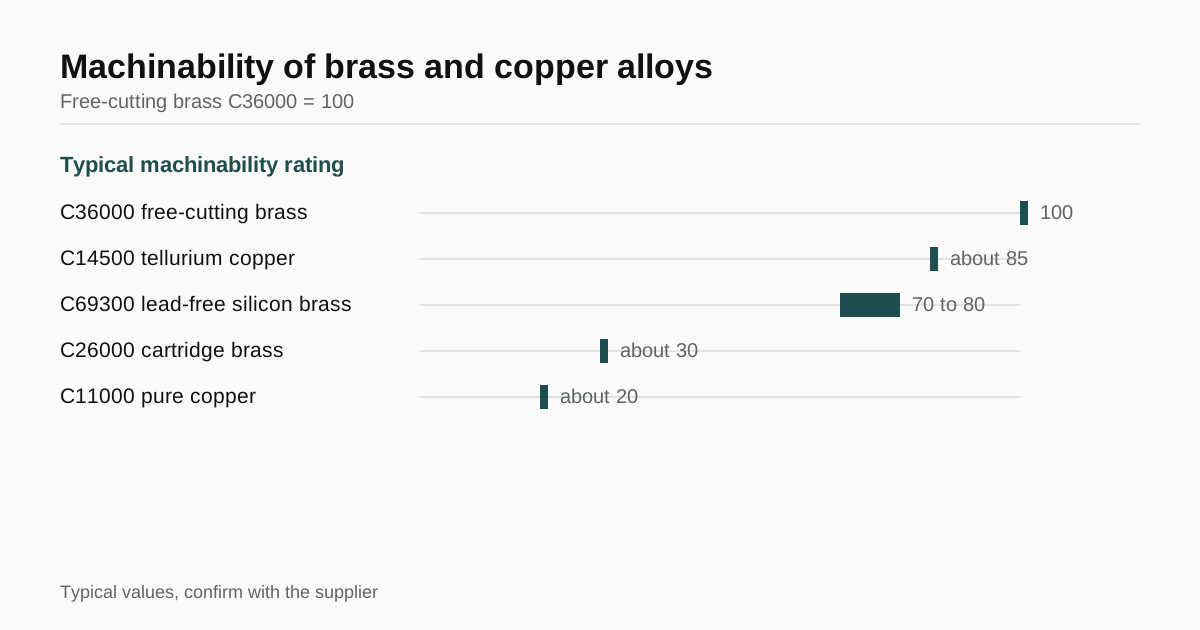
| Alloy | UNS | Main content | Machinability (C360 = 100) | Main use |
|---|---|---|---|---|
| Free-cutting brass | C36000 | About 61 percent Cu, 3 percent Pb | 100 | Fittings, connectors, turned parts |
| Cartridge brass | C26000 | 70 percent Cu, 30 percent Zn | About 30 | Formed and deep drawn parts |
| Naval brass | C46400 | 60 percent Cu, 1 percent Sn | About 30 | Marine fittings |
| Eco brass (silicon) | C69300 | Cu, Zn, Si, no added Pb | About 70 to 80 | Lead-free fittings |
| Pure copper (ETP) | C11000 | 99.9 percent Cu | About 20 | Busbars, contacts, heat sinks |
| Oxygen-free copper | C10100 | 99.99 percent Cu | About 20 | Vacuum, high-purity electrical |
| Tellurium copper | C14500 | Cu with 0.5 percent Te | About 85 | Machinable copper for electrical parts |
| Chromium copper | C18200 | Cu with 1 percent Cr | About 20 | Welding electrodes, high strength copper |
These values are typical references. The same alloy has different names in other systems, for example CW614N for C360 in the European system and C3604 in the Japanese system, as listed in the grade equivalents guide.
C360 brass: the easy one
C360 is the benchmark. Lead particles in the structure break the chip into short pieces, so the tool runs fast, wears slowly and leaves a bright surface. Parts can be turned at several times the speed of stainless steel. The bar is widely available in round, hex and square sections in many sizes, which fits automatic lathes and Swiss-type machines. The Swiss-type guide describes where those machines pay off.
The limits of C360 are its lead content and its strength. It is not for forming or bending, because it cracks, and it should not be used for drinking water, food contact or skin contact where lead is restricted. It also dezincifies in some waters, meaning zinc leaches out and leaves a weak copper structure. Where this is a risk, a dezincification-resistant brass such as CW602N is used.
Copper C110: conductivity first
Pure copper carries electricity and heat better than any common metal. C110, also called ETP copper, has an electrical conductivity of about 100 percent IACS, which is the reference level. It is used for busbars, electrical contacts, terminals, heat sinks and cold plates.
It is not easy to machine. Copper is soft and ductile, so chips tear instead of breaking. They wrap around the tool and the part, burrs are heavy, and thin walls deflect. Shops use sharp, polished tools with high rake angles, generous coolant and light finishing cuts. Cycle times are longer than for brass, and the quote reflects it.
If the part needs copper’s conductivity but is hard to cut, ask about tellurium copper C14500, which keeps about 90 to 95 percent of the conductivity and machines well. For strength with good conductivity, chromium copper C18200 is the standard, though it needs heat treatment and a quote reflecting it.
Lead-free options and when to use them
Lead in brass is a regulatory topic. Rules vary by country and product, so a buyer needs to check what applies to the finished item. Common contexts:
- Drinking water products in the United States must meet the lead-free definition of the Safe Drinking Water Act, with a weighted average of no more than 0.25 percent lead on wetted surfaces. NSF/ANSI 372 is the usual test method. The European Union and other markets have their own rules for materials in contact with drinking water.
- Electrical and electronic products in the EU fall under RoHS, which currently allows up to 4 percent lead in copper alloys under an exemption. That exemption is reviewed from time to time, so check the latest text.
- Consumer goods and children’s products may have their own limits.
For these cases, lead-free brasses replace C360. The common choices are silicon brass (Eco Brass, C69300) and bismuth or selenium based brasses. They machine well, though not quite as freely as C360, and the chips can be harder to break. Bar sizes and availability are narrower, and the price is typically higher. If the part needs a lead-free alloy, state this on the drawing and ask the shop for a certificate that gives the lead content, not just the alloy name.
Choosing between brass and copper for one part
Start from the function. If the part carries current or heat, copper or a copper alloy is the starting point, and the question is which one. If it holds fluid, guides a moving part or simply needs to be corrosion resistant and cheap to turn, brass is the starting point.
For example, a threaded terminal that carries 30 amperes through a panel can be made in C36000 brass with tin plating, since brass conducts about 25 percent as well as copper by volume, which is enough for a short terminal with a generous cross-section. A busbar that carries 400 amperes across a distance cannot. It needs C11000 copper, and the drawing should say so. A heat sink for a power module may use copper for its conductivity, though aluminium at lower cost often wins on weight and price. The aluminium guide covers that alternative.
When both seem to work, ask the shop for a quote on each. The difference in cycle time and material cost usually settles the question within a day.
Plating, finishing and tarnish
Brass and copper tarnish in air. Parts for visible use are lacquered, clear coated or plated. Typical finishes:
- Nickel plating for wear and corrosion resistance, bright or satin
- Tin plating for solderability and low contact resistance
- Silver plating for high conductivity contacts
- Gold plating over nickel for connectors that must stay clean
- Chemical passivation with an inhibitor to slow tarnish
- Clear lacquer for decoration
Plating adds thickness and builds up on threads, so tell the shop which threads and bores need masking. The surface finish guide lists typical thicknesses. If you want a mirror look on brass, state the polishing level, as it is a manual operation priced by the part.
Typical applications and what each asks of the part
Brass fittings for gas and liquid lines call for threads, often tapered pipe threads, and a clean leak-free body with no porosity. Bar stock avoids the porosity risk of castings. Electrical terminals and contacts call for conductivity, a plated surface and flatness at the contact face. Decorative parts such as knobs and bezels call for a finish, polished or satin, with no scratches. Heat sinks and cold plates in copper call for flatness on the mounting face, often 0.05 mm or better, and fine finish for thermal contact.
Each application leads to a different drawing note. A fitting needs a pressure test requirement from you. A contact needs the plating thickness and the conductivity grade. A decorative part needs the cosmetic standard and a master sample. Write these notes in the RFQ so the shop prices the right operations.
Machining notes that explain the quote
- Burrs: copper and brass leave fine burrs on cross holes and slots, so state the edge requirement. The deburring guide shows how to write it.
- Chips and cleanliness: brass chips are fine and sharp. If the part is for an assembly that must be clean, state a cleaning step.
- Thin walls: copper deflects under the cutter. Walls under about 1 mm need care.
- Thermal growth: brass expands about 19 micrometres per metre per degree Celsius, and copper about 17, so measure at a stated temperature for tight tolerances.
- Material waste: brass and copper chips are valuable scrap. Shops normally credit part of it, and a few quote on the net weight.
Material cost and quote validity
Copper and brass bar prices follow the copper market, so they move week by week. A quote for a large brass order may carry a short validity period, for example 7 to 14 days, or a material price clause tied to a published index. Ask about it before you place a large order. The quote breakdown guide describes how material appears as its own line.
Summary checklist
- Name the alloy with its UNS or EN number, not just brass or copper
- State the condition, for example half hard bar or annealed
- Say if lead-free is needed and which rule applies
- Give the plating or finish and mark masked areas
- Allow for burrs and write the edge requirement
- Ask for a mill certificate that lists composition
Once the alloy and finish are on the drawing, send the RFQ. Up to three shops in Vietnam will quote the parts, and we reply within 24 business hours.
Frequently asked questions
Why is C360 brass so common for CNC parts?
C360 is a free-cutting brass with a small lead addition that breaks the chip. It machines faster than almost any other metal, gives a good finish and is the reference grade against which other alloys are rated. It suits fittings, connectors and small turned parts.
Is pure copper hard to machine?
Pure copper such as C110 is soft and gummy. It smears under the tool, forms long chips and leaves burrs, so it needs sharp tooling and careful speeds. For electrical parts that need conductivity, it is the right material, and shops accept the extra time in the quote.
When do I need lead-free brass?
When the part touches drinking water, food or skin, or when your market or customer sets a lead limit. Rules differ by country and product, so check the regulation that applies, then name a lead-free alloy on the drawing and ask for a certificate.
Need a quote for a part like this?
Send the drawing. We shortlist up to 3 machine shops in Vietnam, manage the order if you want us to and reply within 24 business hours.
Send my RFQ