From Prototype to Production: What Changes When a CNC Part Goes From 5 to 500 Pieces
A prototype proves that a part can be made. A production run proves that it can be made again, quickly, at a steady price and with the same result every time. The jump from one to the other is not just more of the same work. The fixtures change, the program changes, the inspection changes and the price curve changes. Buyers who plan for these changes get a smooth transition. Buyers who do not often find that the production quote is a surprise or that the first production lot differs from the prototype.
The prototype is built for speed, not repeatability
A prototype shop makes the part once or a few times. The operator may clamp it in a vise with soft jaws, take a few extra measurements and adjust offsets by hand. The program may carry conservative feeds because a broken tool on a single part means starting again. The unit price is high because every cost is spread across a handful of pieces.
None of this is wrong. It is the fastest way to a sample. But it does not describe what the shop will do at 500 pieces, and the price reflects it.
What production changes
| Area | Prototype (1 to 10 pieces) | Production (hundreds and more) |
|---|---|---|
| Fixture | Vise, soft jaws, tape and clamps | Dedicated fixture, often several parts per cycle |
| Program | Safe feeds, manual checks | Optimised feeds, tool life tracking, probing |
| Cycle time | Long, with pauses | Short, with minimal pauses |
| Inspection | Every dimension on every piece | Sampling plan with critical features checked often |
| Material | One bar or plate from stock | Batch purchase, mill certificate per lot |
| Packaging | Bagged and boxed by hand | Defined pack, tray or foam, labelled |
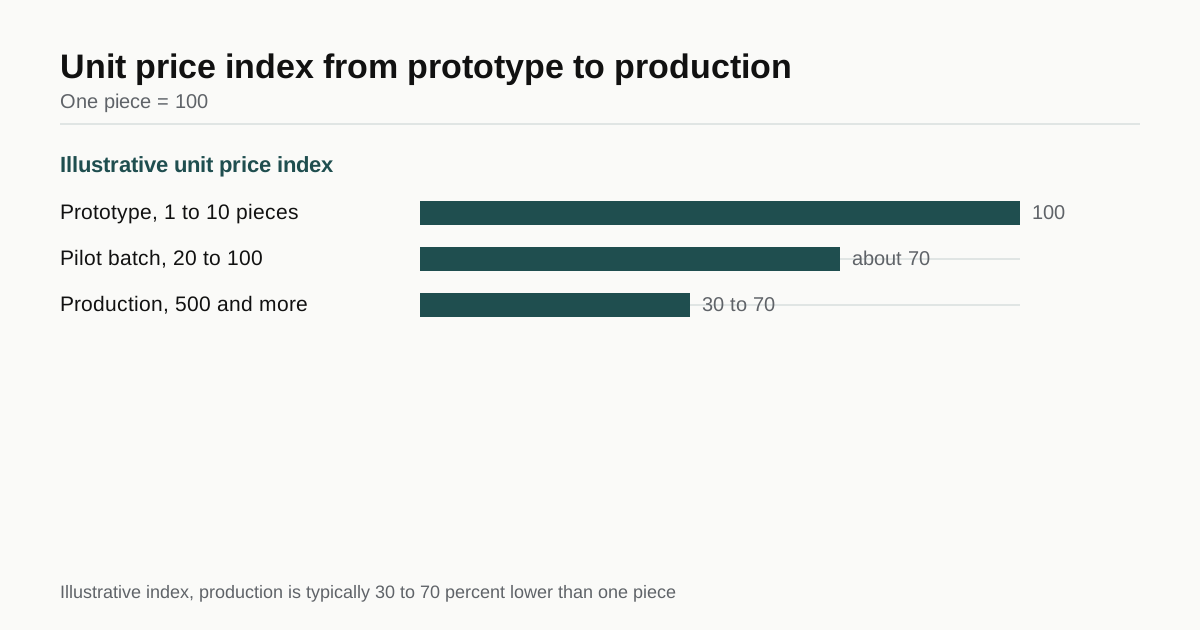
| Unit price | High | Typically 30 to 70 percent lower than at one piece |
The last row is typical and not a promise. The size of the drop depends on how much of the original price came from setup, and on how well the part suits a multi-part fixture.
Fixtures: where most of the saving comes from
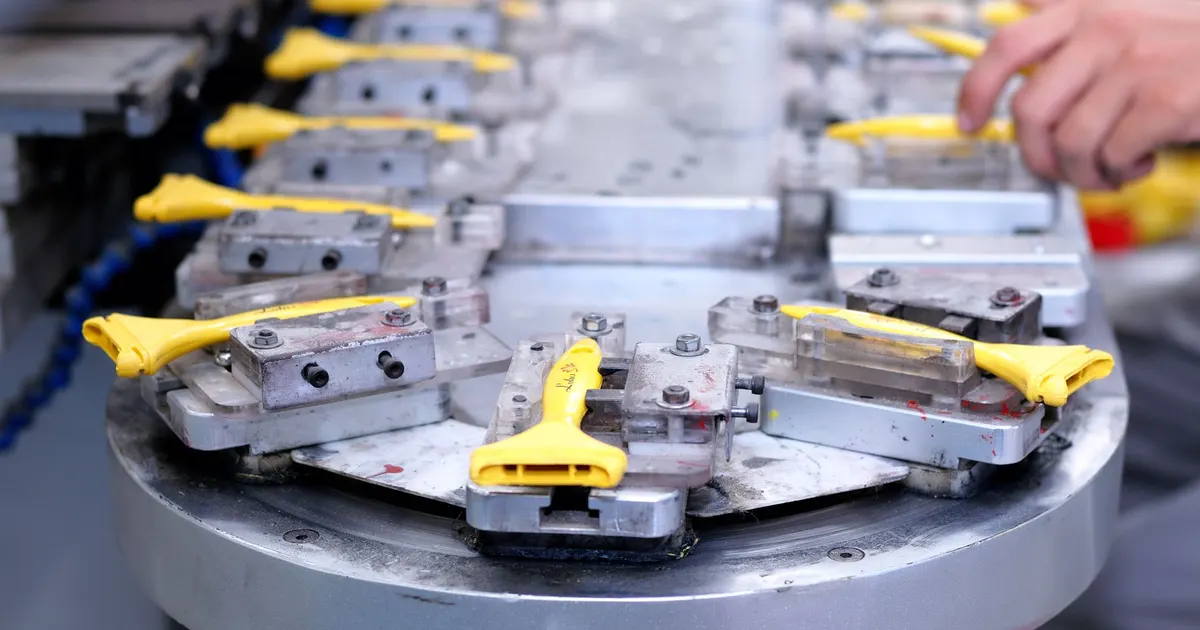
At prototype level the shop clamps the part for each operation using whatever is on the shelf. At production level the shop builds a fixture, either a custom plate with locating pins and clamps or a vise with machined soft jaws that hold the part in one repeatable position. A well-designed fixture holds four, eight or more parts, so the machine cuts the next batch while the operator loads another fixture.
A fixture costs money. It appears on the quote as a one-time tooling charge, or it is built into the unit price over the first run. Ask which. If a fixture is a separate charge, ask who owns it and whether it stays at the shop for repeat orders. You may also ask the shop to store it for 12 months so that repeat orders do not pay for it again. The quote breakdown guide shows where fixture charges sit in the price.
Programs and cycle time
A prototype program is written once and proven on the first part. A production program is rewritten to cut time: shorter tool changes, higher feeds, fewer tools, combined operations. Each saved second multiplies over the run. A part that takes 6 minutes as a prototype may take 3.5 minutes in production, and the shop has paid an engineer to find those 2.5 minutes, so the saving appears in the price only at quantity.
Tool life becomes a cost item. At one piece the shop does not care that an end mill wears 10 percent. At 1,000 pieces tool wear shifts dimensions and the program must compensate or change the tool on a schedule. Shops with probing on the machine measure key features during the cycle and adjust the offset automatically.
Tolerances and design review
A prototype that was made slowly and measured piece by piece may pass a tolerance that production struggles to hold. Production needs a process that holds a tolerance every time, not once. Before you release a production run, review the drawing with the shop:
- Which tolerances were hard to hold on the prototype
- Which features were adjusted by hand
- Whether a change to the design could widen a tolerance without hurting function
- Whether a corner radius or hole size could match a standard tool
These changes cost nothing at prototype stage and save time at production. The design changes guide lists the changes that usually pay back, and the tolerance guide shows how to decide which features need the tight call-out.
Inspection: from every part to a plan
A prototype is measured fully. At production, measuring every dimension on every part takes more time than cutting it. Agree on a plan:
- A full first article report on the first production piece
- Critical dimensions measured on a stated sample, for example 1 in every 10 pieces or 5 pieces per lot
- Go and no-go gauges for threads and key holes on every part
- Visual checks for burrs, scratches and finish on every part
Mark the critical features on the drawing and say which are checked at which frequency. The first article inspection guide explains the first piece step, and it is the document that links the approved prototype to the first production lot.
The pilot batch
A pilot batch sits between the prototype and the full run. Typical sizes are 20 to 100 pieces. The goal is to test the process, not to make parts for sale. Look for these results:
- Fixture holds position across the batch
- Tool wear matches the plan
- Measurements on the sample stay inside tolerance
- Cycle time matches the quote
- Packaging protects the parts during transport
If something fails at 50 pieces, the fix is cheap. If it fails at 2,000 pieces, the scrap is not. A pilot batch costs more per piece and it is usually the cheapest insurance in the project.
A typical timeline
A rough timeline for a part moving from prototype to production looks like this. Prototype order and delivery: two to three weeks. Review of the sample and design changes: one week. Production quote and order: one week. Fixture build and program optimisation: one to two weeks. First article on the production process: three to five days. Pilot lot: two weeks. Full run: two to four weeks, depending on quantity. The whole path from first prototype to the first production lot is therefore often 8 to 12 weeks, which is longer than most buyers hope. Plan it early, and start the production quote while the prototype is still in transit, so the shop can prepare its fixture ideas in parallel.
Material and lot control
Material and lot control
Prototypes often use whatever bar is available. Production needs a consistent source. Ask the shop to buy one lot of material for the first run, with a mill test certificate that you can keep on file. A change in supplier or heat lot can shift machinability and sometimes the final size by small amounts. The materials guide and the quality documents guide cover the paperwork.
Price, lead time and quantity breaks
Ask for prices at three quantities, for example 10, 100 and 500. The difference tells you how much of the price is setup. Also ask for the lead time at each quantity, because a production run needs fixture time before the first part. Typical production lead times from order to ship are longer than for a prototype, often three to six weeks for a first run, as the lead time guide explains. A minimum order quantity may apply, and the MOQ guide shows how shops set it.
Change control
Once production begins, every change to the drawing needs a new revision, written confirmation and a new first article on the changed features. A verbal change that never reaches the drawing is the most common reason a second lot differs from the first. Keep one master drawing and one approved sample, and ask the shop to retain a golden sample from the first lot.
Summary checklist
- Ask for a quote at three quantities
- Review hard-to-hold tolerances with the shop before release
- Ask about fixtures: cost, ownership and storage
- Agree an inspection plan with sampling frequency
- Run a pilot batch before the full order
- Lock the material source and ask for a mill certificate
- Keep a golden sample and a revision log
When you are ready to move from sample to volume, send the RFQ with your target quantities. Up to three shops in Vietnam will quote the run, and we reply within 24 business hours.
Frequently asked questions
Why is the unit price of a production run much lower than a prototype?
A prototype carries the full cost of setup, programming and the first-piece check on a handful of parts. A production run divides those costs over many pieces, adds fixtures that hold several parts per cycle and tunes the program for speed. The cutting time per part may drop by a third or more.
Should I run a pilot batch between the prototype and full production?
Usually yes. A pilot batch of 20 to 100 pieces tests the fixture, the program, the tool life and the inspection plan under real conditions. It costs more per piece than the full run and removes the risk of finding a fixture problem at 2,000 pieces.
Can the same shop that made the prototype make the production run?
Often yes, and it saves time because the program and the knowledge already exist. If the shop lacks capacity or machines for the volume, plan a transfer: share the full package, the approved sample and the inspection records, and expect a new first article.
Need a quote for a part like this?
Send the drawing. We shortlist up to 3 machine shops in Vietnam, manage the order if you want us to and reply within 24 business hours.
Send my RFQ