Machined Parts for Automation Equipment: What to Specify and What Shops in Vietnam Handle Well
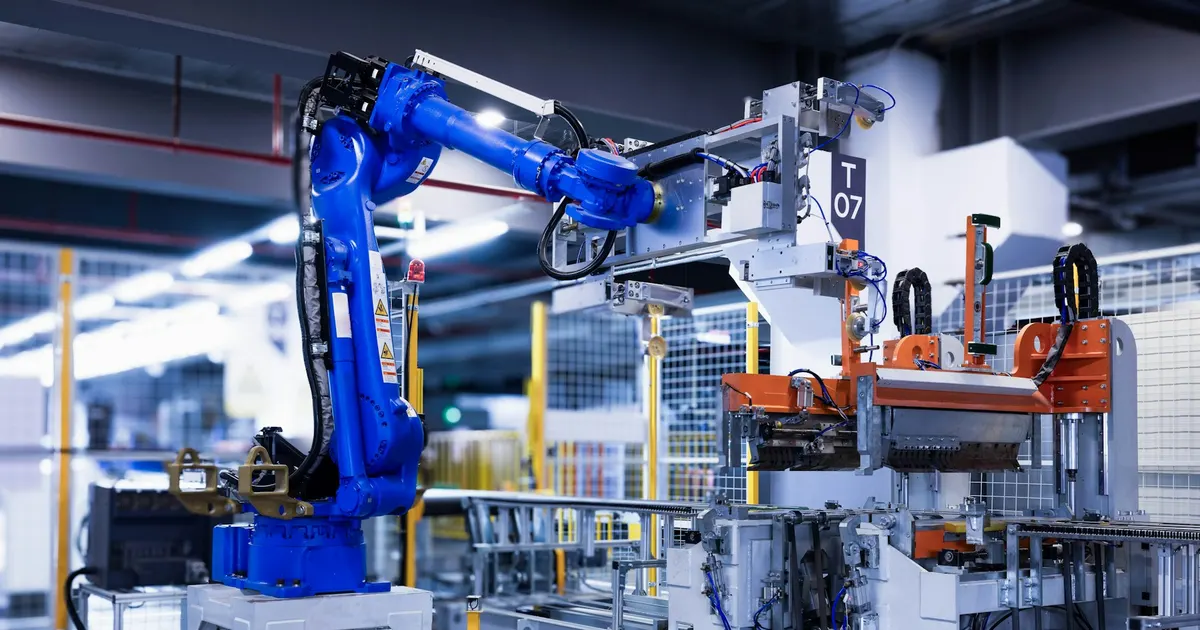
Automation equipment is built from machined parts. A pick-and-place cell, an inspection station or a conveyor module uses base plates, brackets, spacers, gripper fingers, shafts, couplings and sensor mounts, usually in small quantities and many variants. That pattern, many different parts and few of each, suits job shops. It also creates its own sourcing problems: drawings that change, kits that must arrive complete and a few critical surfaces among many ordinary ones. This guide covers how to handle them.
The parts a machine builder buys
A typical automation project includes:
- Base plates and tooling plates, the flat surfaces that carry everything else
- Brackets and angle plates for sensors, cylinders and guides
- Gripper fingers and end-of-arm tooling, often with custom shapes
- Shafts, spacers and bushings for rollers and linear motion
- Couplings and pulley hubs
- Nests and fixtures that hold the product during assembly or test
- Covers and guards in machined or sheet form
Roughly half of these are simple prismatic parts that any competent shop can make. The remaining half carries a few demanding features, and those decide which shop to pick.
Where the tolerance really is
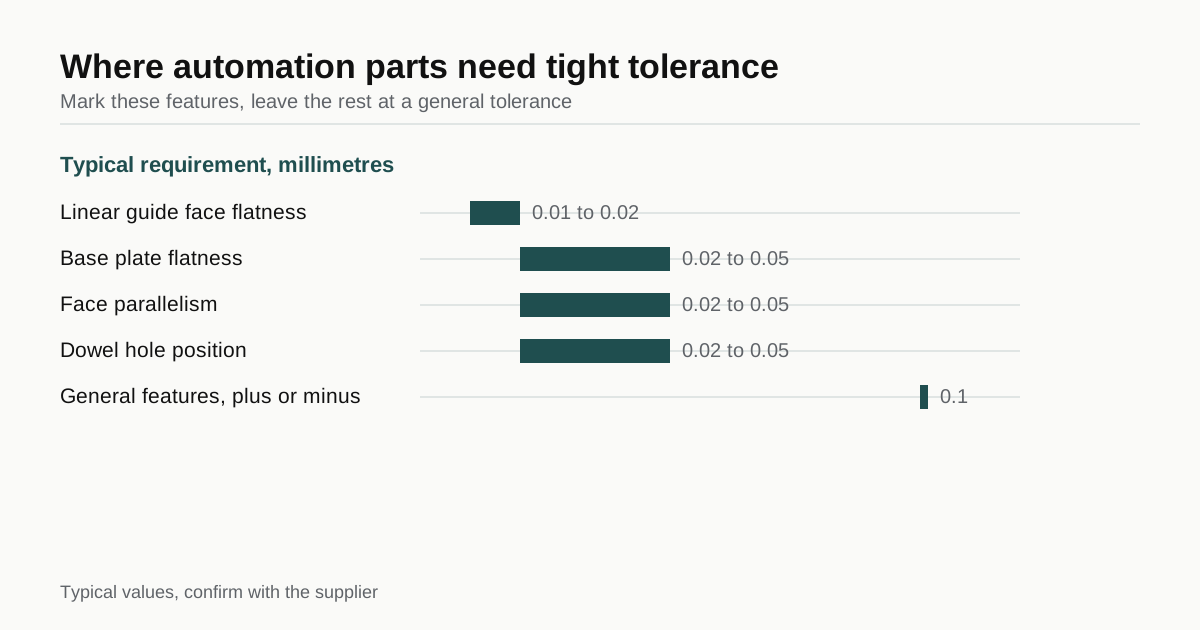
Automation parts rarely need tight tolerance everywhere. They need it at specific places:
| Feature | Typical requirement | Why it matters |
|---|---|---|
| Base plate flatness | 0.02 to 0.05 mm over the plate | Guides and rails follow the plate surface |
| Parallelism of top and bottom faces | 0.02 to 0.05 mm | Keeps the machine level and the axes true |
| Linear guide mounting face | Flatness 0.01 to 0.02 mm, step edge square | Smooth motion, low wear |
| Dowel pin holes | H7, reamed, position 0.02 to 0.05 mm | Repeat location after disassembly |
| Bearing bores | H7 with a stated roundness | Bearing life and runout |
| General holes and pockets | Plus or minus 0.1 mm | Fastener clearance only |
The right approach is to mark the critical features on the drawing, give them tolerances that the function requires, and leave everything else at a general tolerance such as ISO 2768-m. Over-tolerancing the whole plate raises the quote without improving the machine. The tolerance guide explains how to separate the two groups.
Materials that suit automation work
Material choice follows weight, stiffness, cost and wear:
- Aluminium 6061 or 5052 for most plates, brackets and covers, with anodizing for appearance and wear. A cast tooling plate is sometimes chosen for large flat plates because it holds flatness after machining.
- Mild steel (S45C or 1045) for parts that need stiffness, tapped holes with frequent assembly or wear resistance after hardening.
- Stainless 304 for clean areas, wet or food-related machines.
- POM or nylon for nests, guides and wear parts that touch the product, where a soft surface protects it.
- Alloy steel 4140 for shafts and pins that carry load, often with induction hardening.
The aluminium guide and the steel guide help with the common choices. For large plates, ask for stress-relieved stock such as 6061-T651, because a heavily machined plate in ordinary stock can bow after the cut.
Finishes common on automation parts
Machine builders often ask for:
- Black anodize on aluminium, for a uniform look and light wear protection
- Clear anodize where the part sits inside the machine
- Black oxide or electroless nickel on steel
- Bead blast before anodize to hide tool marks
- Hard anodize on moving surfaces
Mask the dowel holes, threaded holes and bearing bores before coating, or state the size after coating. The anodizing guide covers growth and masking.
Kits, labels and revisions
A machine build needs every part at the same time. One missing bracket stops the assembly. That is the real cost of automation sourcing, and it responds to good order handling more than to the cutting itself.
Practical rules:
- Send a bill of materials with drawing number, revision, material, finish and quantity for every part
- Ask the shop to label each part or each bag with the drawing number and revision
- Ask for a single shipment or defined shipments tied to build milestones
- Allow a few spare pieces of small or fragile parts, such as pins and fingers
- Include standard hardware separately, because catalogue screws, bearings and guides should come from a catalogue supplier and not from the machine shop
For a kit of 30 to 100 different parts, a shop that quotes line by line and ships in one lot is a good sign. A shop that answers with a single lump price for a large kit may be hiding the parts it will find difficult.
Revisions and change control
Prototype machines change often. A bracket moves 3 mm, a hole becomes a slot, a plate gains a pocket. Each change risks a part made to the wrong drawing. Good habits:
- Give each revision a letter and update the title block
- Send the changed drawing in writing and ask the shop to confirm which revision it builds
- Ask the shop to scrap or mark any parts already made to an older revision
- Keep a simple change log with the date and reason
If a change affects a part already in production, discuss the cost. A change on a running job can add setup time, and shops differ on whether they charge for it. State your expectation in advance.
Standard parts, modified parts and custom parts
Machine builders often buy a plate or a shaft from a catalogue and ask a shop to modify it, for example by adding tapped holes to a standard plate or turning a step on a standard shaft. This saves cost, because the catalogue part arrives with its flatness and finish already made, and the shop adds only the features that are unique. Ask the shop whether it will machine customer-supplied material. Some do, with a note that they cannot guarantee the incoming part, and some prefer to buy the blank themselves so they carry the material risk.
Choose by quantity and risk. For one machine, a modified catalogue part is often the cheapest path. For a series of machines, a fully custom part with a drawing the shop controls is easier to repeat and to inspect. For anything that must match a mating part exactly, the dowel hole pattern and the mounting face, give the shop the mating drawing too, so it can check the fit instead of working blind.
Common mistakes on automation drawings
Experienced shops notice the same problems again and again. Hole patterns dimensioned from a corner while the machine datum is the centre of a bore, which stacks tolerance. Tapped holes with no depth or with a depth that runs into a cross hole. Pockets with sharp internal corners. Tolerances copied from the plate to every bracket. Missing material and finish notes. A short review of the drawing against these five points before you send it saves a round of questions, and it usually makes the quote arrive sooner and lower. The design changes guide covers several of them.
Lead time and repeat orders
Automation work often has a build schedule with fixed dates. Plan with the lead times the shop quotes, and add time for outside processes such as anodizing or heat treatment. For simple parts without outside processes, delivery of two to three weeks after order is common. The lead time guide gives typical ranges. If you build the same machine repeatedly, ask the shop to store the programs and the fixtures, and to hold a small stock of long-lead material. That shortens repeat orders to days.
Where a part reappears in later machines, keep the same drawing number. A shop that sees the same number twice can reuse the program and the setup, which lowers the quote.
What to check in a shop
Before choosing a shop for automation parts, ask for:
- Machine types and the size of the largest table, so large plates fit
- A surface grinder or access to one for plates that need flatness below 0.02 mm
- A CMM or a height gauge on a granite surface plate for checking flatness and position
- Experience with similar parts, shown by photographs
- A clear way to handle revisions and labels
For first orders, a first article inspection on the critical plate gives you evidence before the whole kit is made.
Summary checklist
- Mark critical features and leave the rest at a general tolerance
- Choose stress-relieved stock for large plates
- Send a bill of materials with revisions and finishes
- Ask for labelled parts in one lot
- Keep catalogue hardware separate
- State how you want revisions handled
- Plan lead time for coatings and heat treatment
Once the drawings and bill of materials are ready, send the RFQ. Up to three shops in Vietnam will quote the kit line by line, and we reply within 24 business hours.
Frequently asked questions
What tolerances do automation parts usually need?
Most brackets and covers work at general tolerances of plus or minus 0.1 mm. Base plates, linear guide mounting faces and locating bores need tighter control, often flatness of 0.02 to 0.05 mm and bores to H7. Mark only those features as critical and leave the rest at the general tolerance.
Can a shop in Vietnam make a full kit of automation parts?
Many can make a kit of 20 to 200 different parts in one order, provided the drawings are consistent and the bill of materials is clear. Ask for each part to be labelled with its drawing number and revision, and for the kit to ship as one lot.
How do I handle revisions on automation parts?
Issue each revision as a new drawing letter, send the change in writing and ask the shop to confirm the revision it is building. Machines under development change often, and a part made to an old revision is a common source of rework.
Need a quote for a part like this?
Send the drawing. We shortlist up to 3 machine shops in Vietnam, manage the order if you want us to and reply within 24 business hours.
Send my RFQ