CNC Machined Aluminium Enclosures: Wall Thickness, Sealing, Finish and Cost
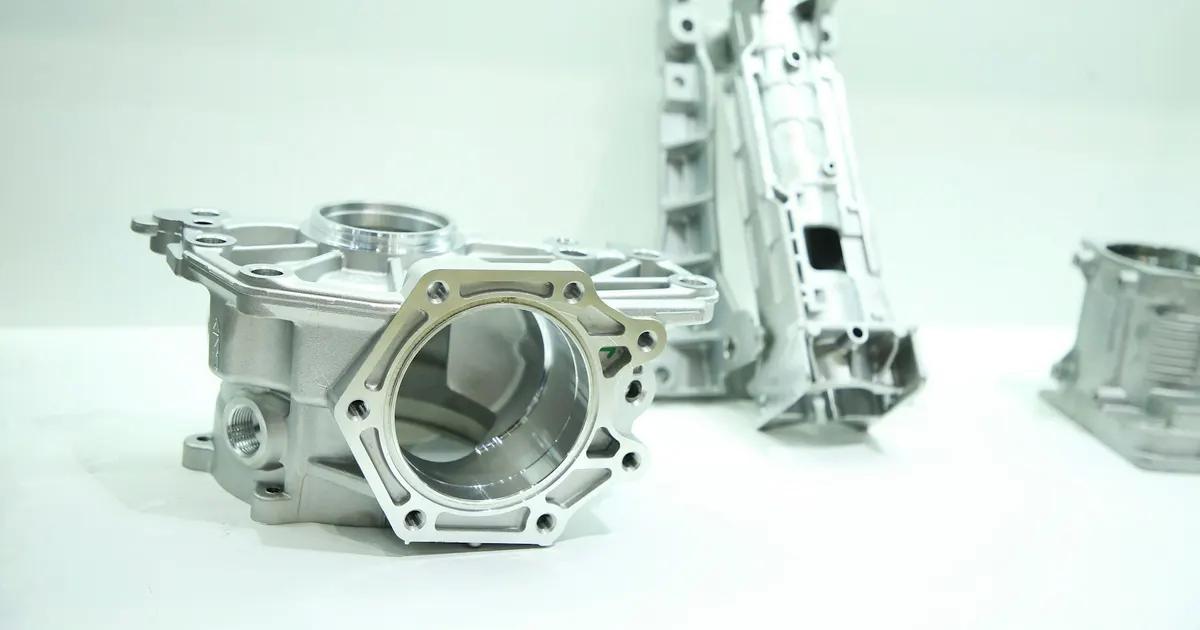
An enclosure looks like a simple part: a box with a lid. It also hides most of the decisions that change cost and quality, such as the starting material, the wall thickness, the sealing surface, the surface treatment and the volume at which a different process becomes cheaper. This guide goes through each of those decisions so you can write a drawing that returns comparable quotes.
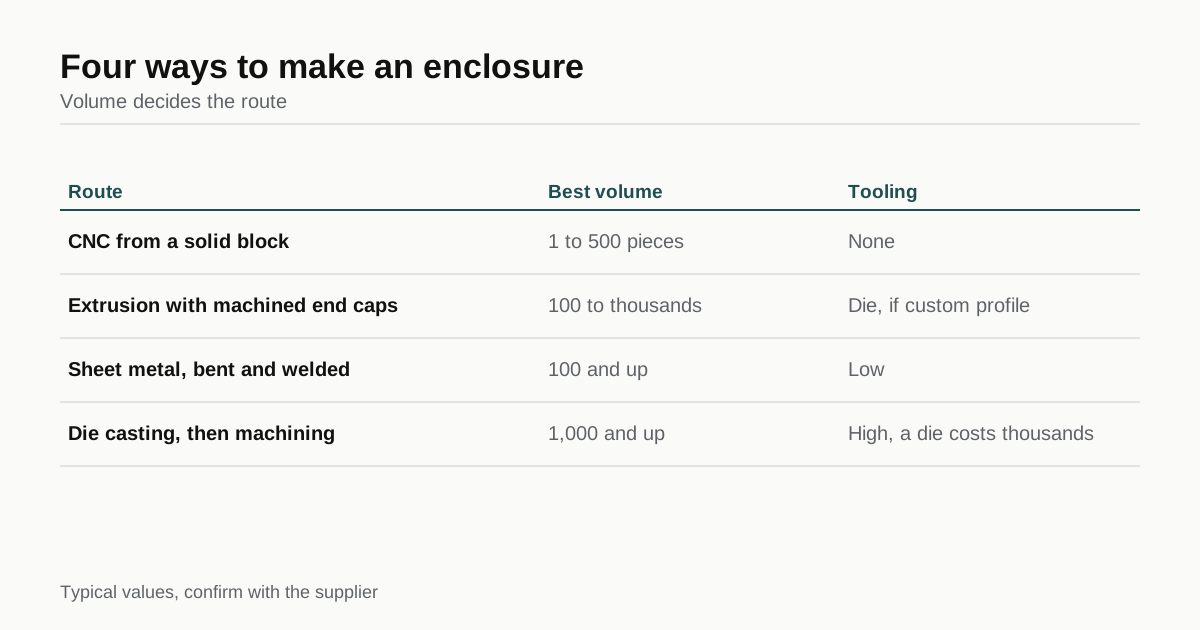
Four ways to make an enclosure
| Route | Best volume | Tooling cost | Design freedom | Typical use |
|---|---|---|---|---|
| CNC from a solid block | 1 to 500 | None | Highest | Prototypes, instruments, small series |
| Extruded profile with machined end caps | 100 to many thousands | Die for the profile, if custom | Constant cross-section | Long housings, heat sinks, power supplies |
| Sheet metal bent and welded | 100 and up | Low | Moderate | Large, thin-wall boxes |
| Die casting, then machining | 1,000 and up | High, a die costs several thousand dollars or more | High | Consumer and industrial volumes |
The crossover points are typical and depend on size and complexity. For a first order of 5 to 200 pieces, machining from a block is usually the quickest to start, since it needs no tooling. A shop can often quote the extrusion option alongside, if a suitable standard profile exists.
Starting material
Most machined enclosures are made from 6061 aluminium, since it machines well, anodizes cleanly, welds if needed and costs less than 7075. Plate in the T651 temper holds flatness after heavy cuts. If the enclosure will see only light loads, 6061 is the default. For thin-walled housings with high stiffness needs, ask the shop about 7075, though its extra cost rarely pays off in a box. The aluminium guide compares the two.
When a large cavity is cut from a solid block, material removal dominates cost. A housing that is 80 percent hollow turns 80 percent of its block into chips, so both the raw material and the machine time are large. A near-net blank, such as an extruded section or a sawn piece close to final size, cuts that cost. State if you will accept a different starting form.
Wall thickness and rigidity
Thin walls are the main source of trouble. A tall, thin wall deflects under the cutter, vibrates and leaves a wavy surface, and it springs back after unclamping. Guidelines shops use, as typical values:
- General walls: 2 to 3 mm in aluminium
- Smallest practical walls: about 1.5 mm, and only on short sections
- Height to thickness ratio: keep under about 10 to 1 for walls that need a good finish
- Floor thickness: at least 2 mm, more for large spans
Deep internal pockets need a long tool, and a long tool is slow. Keep the depth under about four times the width where possible. Internal corners need a radius, and the radius should match a standard cutter size. A radius of 3 mm at the bottom of a deep pocket suits a standard 6 mm tool, while a sharp corner needs a wire process or a different design. The design changes guide lists these rules with their effect on price.
Sealing: IP ratings and gaskets
If the enclosure must keep out dust or water, the design needs a seal. The common approach is an O-ring or a flat gasket in a groove around the lid. Machined features that matter:
- Groove dimensions: width, depth and corner radii follow the seal supplier’s data sheet
- Sealing face flatness: typically 0.05 to 0.1 mm over the face, tighter for large lids
- Surface finish on the seal: about Ra 1.6 to 3.2 micrometres, since a rougher face leaks and a mirror face can let a gasket slip
- Screw spacing: evenly spaced around the lid, usually at distances of 40 to 60 mm for a lid of moderate stiffness
- Anodize on the sealing face: clear anodize is fine, and the thickness affects groove depth
The IP rating, such as IP65 or IP67, is defined by IEC 60529 and is proved by testing the assembled enclosure with its seal, cable glands and lid. A machined part cannot carry an IP rating by itself, so the buyer or a test house confirms it. A shop can produce the geometry from your seal data and can usually advise on the groove if you have not designed one.
Heat and EMI shielding
Aluminium conducts heat well, so a machined housing often acts as a heat sink. Internal pads can press a power component against the wall, and external fins can be machined or extruded. If heat matters, say where the heat source sits and ask the shop about fin height and spacing, which affect tool access.
Aluminium also shields electromagnetic interference, if the joints between lid and body conduct. Anodizing is an insulator, so a sealing face or a grounding point that must conduct is masked, or the part is treated with a conductive chromate conversion coating, such as one to MIL-DTL-5541. Some chromate processes use hexavalent chromium, which is restricted under RoHS and REACH in many markets, so check which version the finisher uses and what your market allows. Mark conductive areas on the drawing.
Fasteners, inserts and threads
Screws into aluminium strip easily if the thread is short or fine. Use coarse threads, engage at least 1.5 times the diameter, or press in threaded steel inserts for parts that are opened often. Name the insert type and the hole size on the drawing. The thread callout guide describes the full note.
Keep screw holes at least one screw diameter away from walls, and add a counterbore or a boss where a screw head needs to sit flat.
Finish and appearance
Enclosures are visible products, and the finish is part of the product. Common choices:
- Bead blast and clear or black anodize for a uniform matte look
- Brushed finish for a directional grain
- Laser engraving for logos and labels, often after anodizing
- Powder coat for colour, at a thickness that changes fits, as the surface finish guide explains
Say which faces are cosmetic. Machining marks, fixture marks and rack marks on visible faces are the most common reasons for rejection. If there is a master sample, supply it. For anodized colours, the anodizing guide covers batch matching.
Cable entries, connectors and panel cutouts
Enclosures exist to carry things in and out. Connector cutouts, cable glands, switch holes and display windows each add machining time, and each needs a tolerance that matches the part that goes into it. A round connector with a panel nut needs a hole to a stated diameter with a flat for the anti-rotation key. A rectangular cutout needs corner radii matching a standard cutter, and the radii should be as large as the connector allows. Sharp-cornered rectangular holes in a thick wall need a different process, such as wire cutting, and cost more.
List the components and attach their datasheets with the RFQ. A shop can then check each cutout against its connector, flag clashes and propose standard cutter radii. For glands, give the thread, for example M20x1.5, and the wall thickness, so the thread engages fully. The thread callout guide shows how to write each.
Labels, engraving and marking
Text and logos on an enclosure can be laser engraved, CNC engraved or printed. Laser engraving on anodized aluminium removes the dye layer and leaves a bright mark, typically legible at a text height above 2 mm. CNC engraving cuts a groove, which can be filled with paint. Printing, such as pad or screen printing, sits on the surface and wears faster. State the method, the text height, the font and the position, and supply the artwork as a vector file. If the marking must survive cleaning or abrasion, mention it.
What drives the price
What drives the price
Four things move the price most:
- Volume of material removed, which sets machine time and material waste
- Number of setups, one per face that needs machining from a new direction
- Thin walls and deep pockets, which need slow cuts
- Finish and cosmetic standard, which can add as much as the machining
If you give a target price, the shop can propose changes. A common one is to replace a solid block with an extrusion, or to combine two parts into one. Quote at two or three quantities, such as 10, 50 and 200, so the curve is visible.
Summary checklist
- Choose the route: block, extrusion, sheet or casting, by volume
- Keep walls at 2 mm or more where possible
- Give the seal data and mark the sealing face
- Mark conductive surfaces for EMI shielding
- Specify inserts and thread depth
- State cosmetic faces and the finish
- Ask for quotes at several quantities
With those lines on the drawing, send the RFQ. Up to three shops in Vietnam will quote the enclosure, and we reply within 24 business hours.
Frequently asked questions
Should an enclosure be machined from a block or from an extrusion?
An extruded profile with machined end caps is usually the cheaper route for a long, uniform housing in volume. A solid block gives full design freedom, such as internal ribs, mixed wall thickness and compound shapes, and suits small and medium batches. A shop can quote both from the same drawing.
What is the minimum wall thickness for a machined aluminium enclosure?
A practical minimum is about 1.5 mm for small features and 2 to 3 mm for general walls. Thinner walls vibrate under the cutter, leave a poor finish and deform when clamped. Taller walls need more thickness, and the shop will advise on a ratio of height to thickness.
How do I get an IP-rated enclosure from a machined part?
The enclosure needs a groove for an O-ring or gasket, a flat and smooth sealing face and screws spaced evenly around the lid. The IP rating is then proved by a test of the assembled unit. The machined part supplies the geometry, and the buyer or a test house confirms the rating.
Need a quote for a part like this?
Send the drawing. We shortlist up to 3 machine shops in Vietnam, manage the order if you want us to and reply within 24 business hours.
Send my RFQ