Automotive Aftermarket CNC Parts: How to Source Billet and Replacement Parts in Vietnam
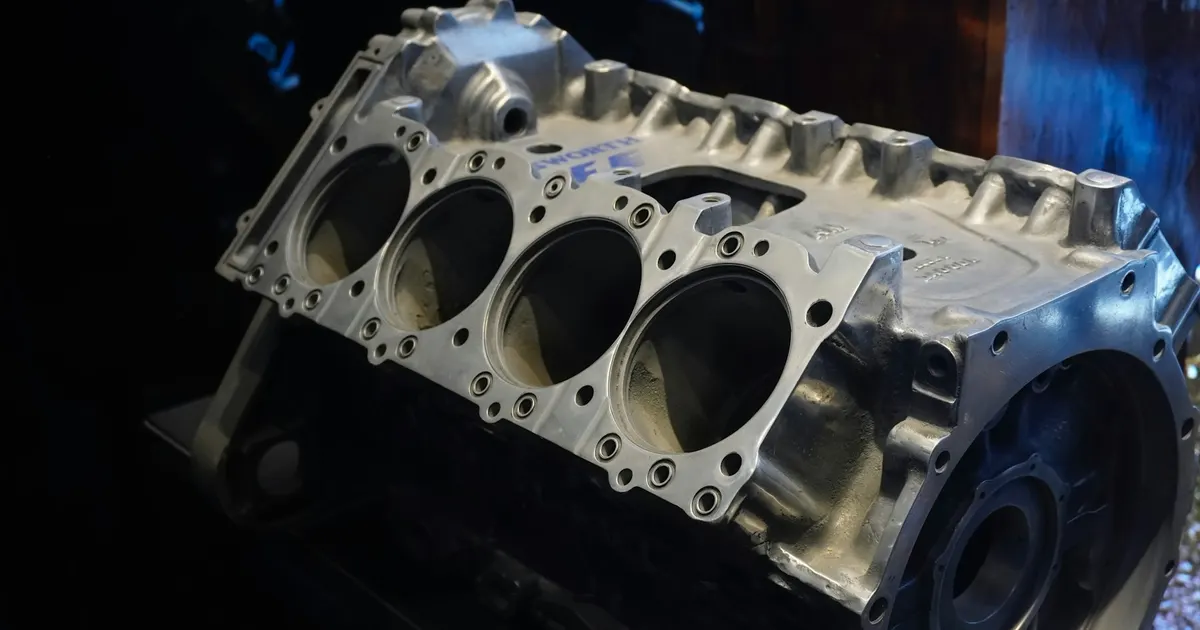
Aftermarket automotive and motorcycle parts are a good fit for CNC machining. Volumes are modest, designs change often, and customers pay for a good finish. Billet brackets, spacers, pulleys, adapters, caps, levers, hubs and shift parts are made this way in every country that has car and motorcycle enthusiasts. For a buyer sourcing from Vietnam for the first time, the questions are practical: which materials, which finish, how to treat safety-critical parts and how to ship retail-ready goods.
Parts that suit CNC machining
| Part type | Typical material | Process notes | Common finish |
|---|---|---|---|
| Billet brackets and mounts | 6061-T6 or 7075-T6 | 3-axis or 3+2 milling | Anodize, bead blast |
| Spacers, bushings and sleeves | 6061, 4140, brass | Turning | Anodize, zinc, black oxide |
| Pulleys and sprockets | 6061, 7075, 1045 | Turning and milling, hobbing for teeth | Hard anodize, nitride |
| Intake and throttle adapters | 6061 | Milling, turning | Anodize, powder coat |
| Levers, pedals and shift parts | 7075, 6061 | 3-axis milling | Anodize, polish |
| Caps, knobs and trim | 6061, 303, brass | Turning, engraving | Anodize, plating, polish |
| Axles, pins and shafts | 4140, 4340, 1045 | Turning, grinding | Heat treat, zinc, black oxide |
| Brake and clutch adapters | 4140, 6061 | Milling, boring | Per your validation |
These are typical choices. Your engineering team decides the final material and process for each part.
Materials and why they differ
For most billet parts, 6061 is the default. It machines well, anodizes in many colours and costs less than 7075. 7075 is chosen for levers, brackets and pedals that carry higher loads. The 6061 and 7075 guide compares them in detail.
For shafts, axles and pins that carry load, alloy steel such as 4140 is common, with heat treatment to a stated hardness. The steel guide explains how to write that. For fasteners and fittings that must resist rust, 303 or 304 stainless is used, and the stainless guide helps with the choice. Brass suits decorative caps, and the brass guide covers the options.
Finish drives the look and the price
Aftermarket customers buy with their eyes first. A bracket that works and looks uneven does not sell. Finish choices:
- Anodize in colours: red, blue, gold, black and clear are common. Colour consistency across batches matters, and the anodizing guide explains how to control it.
- Bead blast before anodize, to hide tool marks and give a matte look
- Polishing, by hand or machine, for a mirror face on visible parts. It is priced per part.
- Laser engraving of a logo or part number, applied before or after anodizing depending on the look wanted
- Powder coat in wrinkle black or colour, at a thickness that affects fits
- Zinc or black oxide on steel parts
Always state which faces are cosmetic. Fixture marks, rack marks and handling scratches show most on a finished piece. Ask the shop to bag parts individually after finishing, and see the export packing guide for how to specify this.
Safety-critical parts need different handling
Some aftermarket parts affect safety: brake adapters, steering and suspension components, wheel spacers and hubs, engine mounts and clutch parts. A failure can injure someone, and in many markets the seller carries product liability. For these parts:
- Validate the design yourself. Calculation, testing and, where needed, approval by an authority are your job, not the shop’s.
- Control the material. Require a mill certificate and keep the heat number against the lot.
- Define the heat treatment and require a hardness record on finished parts.
- Inspect more. Require a full first article and a defined sampling plan for critical dimensions. The first article inspection guide shows what to ask.
- Keep records, including the drawing revision, inspection data and lot numbers, so you can trace any part.
A shop that works carefully will say so and ask about these points. A shop that quotes a safety part without asking about the material or the heat treatment deserves a second look. This site matches RFQs with shops and does not validate parts. Responsibility for safety-critical designs stays with you.
Branding, marks and intellectual property
Engraving your own logo is routine. Copying another company’s design or mark is not, and responsible shops decline it. If your part is a replacement for an original, describe its fit and function, not the original maker’s name or logo. If you hold a design from a customer, confirm that you have the right to have it made. A good quote request includes your own artwork, the engraving depth and the location.
Batch sizes and process choice
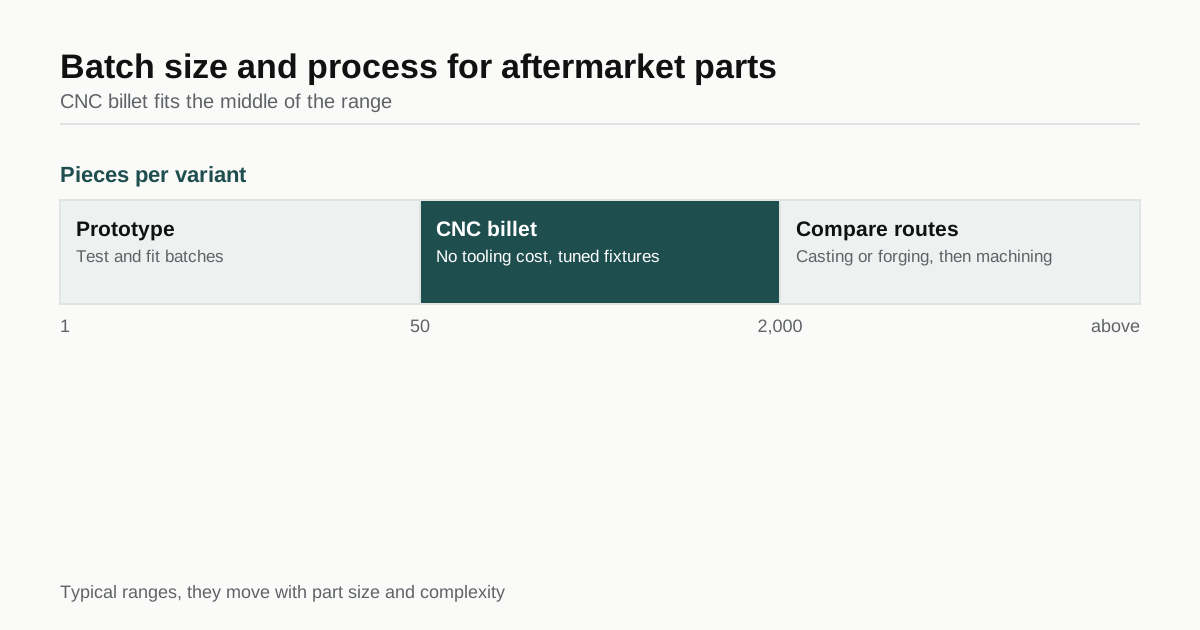
CNC machining suits aftermarket volumes because there is no tooling cost for the part. But there is a limit. Typical guidance, which varies by part:
- 1 to 50 pieces: prototype and test batches, machined from bar or plate
- 50 to 2,000 pieces: the sweet spot for billet parts, with fixtures and tuned programs
- Above 2,000 pieces: compare forging, casting or extrusion followed by machining, which costs tooling but lowers the unit price
A shop can quote both routes if you ask. For a part that sells slowly in many variants, such as a bracket for many models, machined parts avoid the stock risk of a casting die. The prototype to production guide covers the step from sample to batch, and the MOQ guide explains how shops set minimums.
Example: a billet pulley kit
Consider an aftermarket pulley kit for a popular engine, made in three sizes. Each pulley is turned and milled from 6061-T6 bar, with a keyway or a bolt pattern, hard anodized in black and laser engraved with the brand and size. The buyer orders 300 pieces of each size, 900 in total, across one order.
A shop quotes the three variants with one fixture family and one program per variant, and the price per piece falls once the batch passes about 200. The buyer approves a first article of each size, including bore size, runout and anodize thickness, then releases the batch. Parts are bagged one by one, labelled by size and packed in cartons of 50. The sequence is ordinary, and it works because the buyer supplied the drawing, the finish, the engraving file and the packing rule at the quote stage. Variants with different bolt patterns share the same blank, which keeps the material cost low. This is the pattern to copy for any family of parts that differ by one dimension.
Retail-ready packing and labelling
Aftermarket parts are often shipped straight to a warehouse that sells to consumers. Ask the shop to:
- Bag each part, with a label carrying the part number, and a barcode if you have a scheme
- Insert a card or foam if the finish scratches easily
- Pack in a retail box with your artwork, if you supply it, or in plain cartons
- Group by variant, with the part number on the carton
A packing line takes time and labour, and it appears as a line on the quote. Ask for it separately so you can compare.
Quality records worth asking for
Automotive original equipment suppliers work under formal quality systems, such as IATF 16949 and PPAP, which are written for production supply to vehicle makers. Aftermarket orders rarely need the full set, and a small shop may not hold it. A practical subset is enough for most aftermarket parts: a first article report, a material certificate per lot, a dimensional check on critical features per batch, a finish thickness record for anodized parts and photographs before shipping. For heat-treated parts, add a hardness record. Ask the shop what it records as routine, and write the rest into the order. Do not assume a shop holds a certificate unless it shows the document, and check it with the issuing body.
Shipping and customs
Parts from Vietnam enter most markets under standard tariff headings, often 8708 for motor vehicle parts and 8714 for parts of motorcycles and cycles. Your customs broker decides the classification and the duty. The landed cost guide shows how to add duty, freight and handling to the part price, and the importing guide outlines the paperwork. Ask the shop for a commercial invoice that describes the parts clearly, since vague descriptions slow customs.
Summary checklist
- Choose the material by load, with 6061 as the default for billet aluminium
- State the finish, colour and cosmetic faces
- Treat safety-critical parts with validation, traceability and heat treatment records
- Use your own logo only, as a vector file
- Compare CNC against casting or forging above a few thousand pieces
- Ask for individual bagging, labels and retail packing as separate lines
- Plan for duty and freight in the landed cost
With the drawing and finish notes ready, send the RFQ. Up to three shops in Vietnam will quote the parts, and we reply within 24 business hours.
Frequently asked questions
Can shops in Vietnam make safety-critical aftermarket parts such as brake or suspension components?
A shop can machine them to your drawing, but safety-critical parts need your own design validation, material control, heat treatment records and testing. Treat them as controlled parts with a full first article, batch traceability and a test plan. A shop cannot carry that responsibility for you.
What batch sizes suit aftermarket CNC parts?
Billet aftermarket parts typically run in batches of 50 to 2,000 pieces per variant. At low volume, 3-axis and turned parts are cost-effective. Above a few thousand pieces, forging, casting or extrusion with machining often becomes cheaper, and a shop can help compare.
Can I have my logo engraved on the parts?
Yes. Laser engraving or CNC engraving of your own logo is routine. Do not ask for another company's logo or marks, because trademark law applies and a responsible shop will refuse. Supply your artwork as a vector file and state the depth and position.
Need a quote for a part like this?
Send the drawing. We shortlist up to 3 machine shops in Vietnam, manage the order if you want us to and reply within 24 business hours.
Send my RFQ